CHANCE OF STORMS: NOAA forecasters estimate a 25% chance of polar geomagnetic storms on Dec. 2nd when a CME might deliver a glancing blow to Earth's magnetic field. High-latitude sky watchers should be alert for auroras. Aurora alerts: text, voice
CHINA LAUNCHES LUNAR ROVER: Move over USA and Russia, China is about to join the club of nations who have landed on the Moon. Earlier today, China's Chang'e-3 spacecraft blasted off from the Sichuan province in southwest China. Chang'e-3 is carrying a six-wheeled, 260-lb rover named the "Jade Rabbit" ("Yutu" in Chinese), which could touch down on the lunar surface as early as Dec. 14th:

An artist's concept of the Jade Rabbit's roll-out onto the lunar surface.
Unlike the soft landings of unmanned spacecraft from the USA and the Soviet Union, Chang'e-3 will be able to survey the landscape first and determine the safest spot. The most likely destination is Sinus Iridum, the Bay of Rainbows.
A Chinese-made nuclear battery will power the rover after it lands on the lunar surface. Using plutonium-238, the battery will last for more than 30 years. The rover also has expandable solar arrays to absorb the sun’s energy during the day and retract at night to cover and protect equipment from temperatures of minus 170 degrees Celsius. Onboard sensors include a ground-probing radar, cameras, and a soil sampler.
Jade Rabbit's name comes a Chinese myth: According to the ancient story, a lady called Chang'e swallowed magic pills, which allowed her to fly to the Moon along with her pet rabbit "Yutu". There she became a goddess, and has been living on the Moon with the white rabbit ever since.
Congratulations to the people of China for their successful launch and lunar ambitions!
COMET ISON DIES ... AGAIN: Comet ISON is fading fast as it recedes from the sun. Whatever piece of the comet briefly survived its Thanksgiving Day brush with solar fire is now dissipating in a cloud of dust. Click to view a 4-day movie updated @ 0100 UT on Dec. 1st:

This development makes it unlikely that Comet ISON will put on a good show after it exits the glare of the sun in early December. Experienced astrophotographers might be able to capture the comet's fading "ghost" in the pre-dawn sky, but a naked-eye spectacle is out of the question.
On Nov. 29th, pilot Brian Whittaker tried to catch a first glimpse of Comet ISON from Earth, post-perihelion, from a plane flying 36,000 feet over the Arctic Circle in northern Canada. No luck:
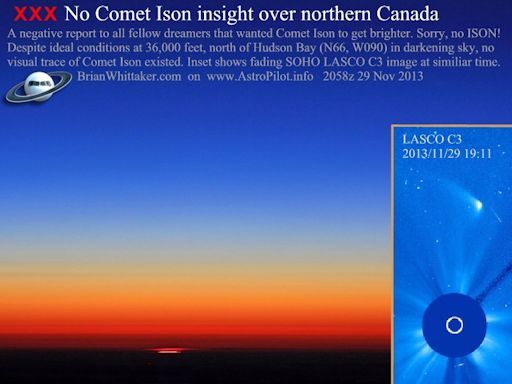
"Ideal viewing conditions from the Arctic revealed no Comet ISON," reports Whittaker. "This negative report is to quench the thirst of other fellow dreamers under cloudy skies or further south. Later I could see that SOHO showed the comet dimming further."
Despite Whittaker's negative result, it is too soon to rule out observations from Earth as the twice-dead comet moves away from the glare of the sun. Meanwhile, NASA's fleet of solar observatory will be tracking the remains. Stay tuned for more images.
Realtime Comet ISON Photo Gallery
Realtime Space Weather Photo Gallery