M-CLASS FLARE: Solar activity ticked upward slightly on Dec. 7th at 07:29 UT with an M1-class solar flare from sunspot AR1909. NASA's STEREO probes detected a CME emerging from the blast site, near the sun's southwestern limb. Earth could receive a glancing blow from the CME on Dec. 9-10. The flare also produced strong VHF radio emissions and a wave of ionization in the over Europe: data. Solar flare alerts: text, voice
THE GHOST OF COMET ISON: Yesterday, Dec. 6th, leading researchers from the Comet ISON Observing Campaign (CIOC) held an informal workshop at the Johns Hopkins Applied Physics Lab. One of the key questions they discussed was, Did Comet ISON survive? It might seem surprising that anyone is still asking. After all, the "comet" that emerged from the sun's atmosphere on Thanksgiving day appeared to be little more than a disintegrating cloud of dust. This movie from the STEREO-A spacecraft (processed by Alan Watson) shows the V-shaped cloud fading into invisibility on Dec. 1st:

The answer hinges on the contents of that cloud. Is it nothing more than a cloud of dust--or could there be some some fragments of the disintegrated nucleus still intact and potentially active?
A key result announced at the workshop comes from SOHO, the Solar and Heliospheric Observatory. According to the spacecraft's SWAN instrument, the comet stopped producing so-called Lyman alpha photons soon after its closest approach to the sun. Karl Battams of the CIOC explains what this means: "Without getting technical, Lyman-Alpha is a consequence of sunlight interacting with hydrogen, and if we are not seeing that interaction then it means that the levels of hydrogen (and hence ice) are extremely low. This is indicative of a completely burned out nucleus, or no nucleus at all."
"The evidence appears strong that at some point approaching perihelion - whether days or hours - Comet ISON likely began to completely fall apart," he continues. "What remains of ISON now is going to be either just a cloud of dust, or perhaps a few very depleted chunks of nucleus. Either way, it's not going to flare up at this point and we should assume the comet's show is over."
"However, we do need to verify this," says Battams. "Hopefully the Hubble team can come to the rescue! In mid-December, Hubble will be pointed in the direction of where ISON should be and they'll try and image something. If no fragments are surviving, or they are tiny, then Hubble will not be able to find anything, but that negative detection will tell us something: namely that ISON is indeed gone for good."
THE CRESCENT OF VENUS: Lately, have you noticed an extremely luminous star in the southwest after sunset? That's no star. It's Venus. If you have binoculars or a small telescope, take a closer look. Like the Moon, Venus has phases and tonight it is a 25% crescent:
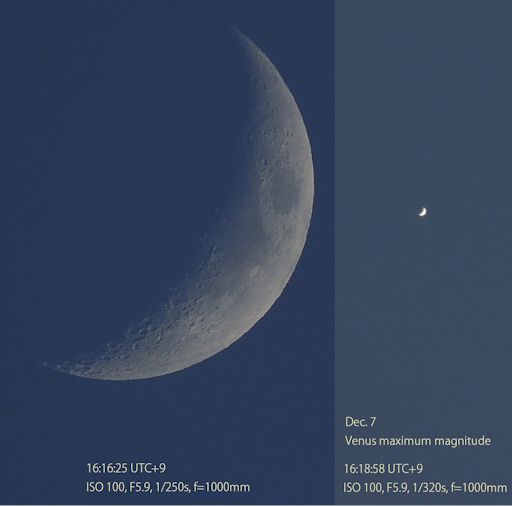
Shiraishi of Kumagaya-shi, Japan, took these pictures of the Moon and Venus on Dec. 7th. "I wanted to photograph the two crescents using the same focal length and almost same exposure conditions," he says. "I used a Nikon COOLPIX P510 digital camera--no telescope required!" For other photographers who wish to try this, complete photo settings may be found here.
Right now, Venus is at its maximum brightness for all of 2013. On the scale of astronomical magnitudes, the planet registers -4.7. That means it is almost 200 times brighter than a 1st-magnitude star. There will never be a better time to catch the Venusian crescent. Go outside tonight after sunset, face SW, and take a look!
Realtime Space Weather Photo Gallery
COMET LOVEJOY'S ACTIVE TAIL: Amateur astronomers around the northern hemisphere are reporting activity in the tail of naked-eye Comet Lovejoy (C/2013 R1). In Nagano, Japan, astrophotographer Kouji Ohnishi could see big changes in less than an hour of monitoring:

Michael Jäger saw the same "disconnection event" from his observatory in Masenberg, Austria, on Dec. 5th. The disturbance could be caused by a gust of solar wind or perhaps an episode of vigorous outgassing in the comet's core.
Comet Lovejoy is now about as bright as a 4th magnitude star. It is visible to the unaided eye from the countryside and is an easy target for backyard telescopes even in urban areas. Monitoring is encouraged. Comet Lovejoy rises in the east just before the morning sun. Sky maps: Dec. 6, 7, 8, 9.


