ELECTRIC-BLUE CLOUDS OVER ANTARCTICA: A vast bank of electric-blue clouds has appeared over the south pole, signaling the start of the season for southern noctilucent clouds. According to data from NASA's AIM spacecraft, the clouds appeared earlier than usual this year. Researchers say this could be a sign of climate change: full story.
SOLSTICES IN A BEER CAN: The northern winter solstice is today. In the Netherlands that means it's time to open up a beer can and look inside. Every six months, Jan Koeman of Zierikzee, the Netherlands, deploys a beer-can solargraph to record the progress of seasons, solstice to solstice. On Dec. 18th he cracked his open and this is what he saw:
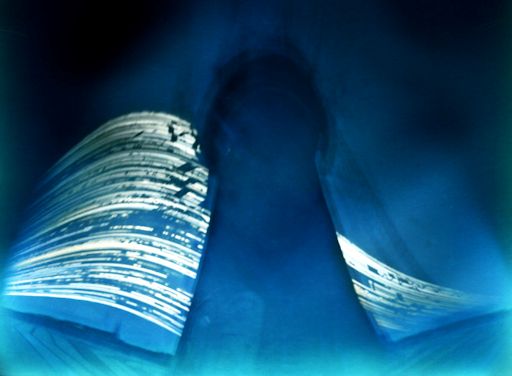
"I made a solargraph using an empty beer tin with a pinhole and photographic paper inside," explains Koeman. "The exposure time is 6 months!"
The highest arcs were traced by the summer sun ofJune 2013. The lowest arc was made by the sun on Dec. 18th, just three days before the 2013 winter solstice. Occasional gaps are caused by clouds.
"This year I placed my solargraph high and safe on an old Dutch windmill," continues Koeman. "The miller is always busy and we have a lot of wind here, so the spinning wings of the mill are barely visible in the photo."
Readers: Northern winter begins on Dec. 21st at 17:11 UT. Now is the perfect time to deploy your own beer-can solargraph for the next six months. Too young to drink? Soda cans work, too. 6-month Solargraph How-to Guides: #1, #2, #3 Solar flare alerts: text, voice
Realtime Space Weather Photo Gallery
BON VOYAGE, GAIA: On Dec. 19th, the European Space Agency launched one of the most ambitious astronomy missions ever: GAIA, an observatory that will survey more than one billion stars in the Milky Way. By the time GAIA's five year mission is over, astronomers will be able to build the first accurate three-dimensional map of celestial objects in our home galaxy. GAIA will do its work from the L2 Lagrange point approximately 1.5 million km from Earth. On Dec. 20th, amateur astronomer Dave Eagle of Higham Ferrers UK observed the spacecraft hurtling toward that distant station:
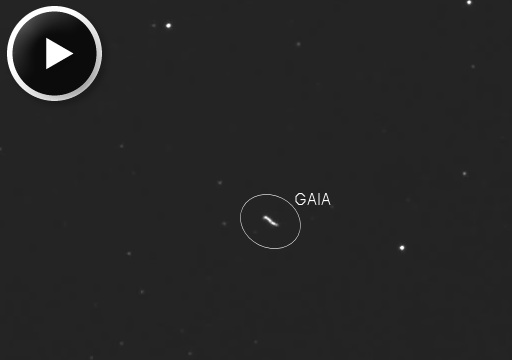
"It was great to see the spacecraft in the exact position predicted, near the shield of Orion," says Eagle. "After watching the launch live on the Web in the morning, I was glad to be able to track it down and wish it well in its coming mission. It was much brighter than I expected, so its newly deployed Sun shield is doing a great job."
Once it reaches its L2 parking orbit and begins observing, GAIA will log the position, brightness and color of every star that falls within its field of view. By repeating these observations throughout its mission, astronomers will be able to calculate the distance, speed and direction of motion of each star GAIA sees, chart variations in their brightness, and determine whether they have nearby companions. This kind of detailed information about the Milky Way is unprecedented and may lead to important new discoveries about the evolution and structure of our galaxy. For updates about GAIA, stay tuned to the ESA.
Realtime Space Weather Photo Gallery