CHANCE OF FLARES: Big sunspot AR1928 is crackling with M-class solar flares. Magnetic fields spiraling away from the sunspot's location on the sun's western limb are well-connected to Earth, raising the possibility of a radiation storm around our planet if the flares intensify. NOAA forecasters estimate a 60% chance of M-class flares and a 10% chance of X-class flares on Dec. 23rd. Solar flare alerts: text, voice
CHRISTMAS CONJUNCTION IN SPACE: According to some scholars, the Star of Bethlehem might have been a close encounter between Venus and Jupiter. The two brightest planets in the night sky, merged, would have made a spectacle of Biblical proportions. This Christmas, NASA's STEREO-B probe is observing something similar. Instead of Jupiter and Venus merging, however, the combined planets are Jupiter and Earth:

STEREO-B is located on the far side of the sun where it can look back and see Earth along with other planets in the Solar System. From STEREO-B's point of view, Earth and Jupiter are so close together that the spacecraft's Heliospheric Imager can barely tell the two apart. Venus is only 2 degrees from the Earth-Jupiter pair, so this is actually a 3-way conjunction.
This meeting is not nearly as tight as the putative Star of Bethlehem conjunction ~2000 years ago. At that time Venus and Jupiter could have been as little as 6 arcseconds (0.00166 degrees) apart. Nevertheless, the ongoing display is still special because it's the first "Christmas Star conjunction" from space. Happy Holidays from STEREO!
Realtime Space Weather Photo Gallery
ANALEMMA 2013: If you took a picture of the sun at the same time each day, would it remain in the same position? The answer is no, and the figure-8 shape traced out by the sun over the course of a year is called an analemma.
Japanese photographer "Shiraishi" stitched together more than 50 pictures spanning 12 months to reveal the analemma of 2013 over the city of Kumagaya-shi in Saitama, Japan:
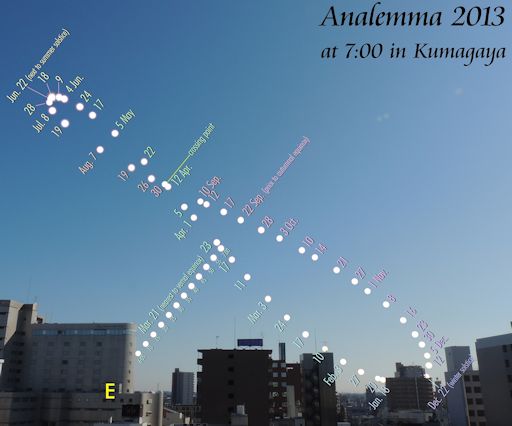
"My analemma project started on December solstice in 2012 and finished on December solstice in 2013," says Shiraishi. "This photo contains the sun images from Jan. 18 to Dec. 22, that is, all the sun images are only in 2013."
The upper and lower tips of the "8" represent the solstices--the longest and shortest days of the year. Now the Japanese sun is at the bottom. Winter has arrived!
Other planets have analemmas, too. Not all are figure-8s, however. The shape depends on the tilt of the planet's spin axis and the eccentricity of its orbit around the sun. Martian analemmas resemble a teardrop, while Jupiter's analemma looks like a jelly-bean:
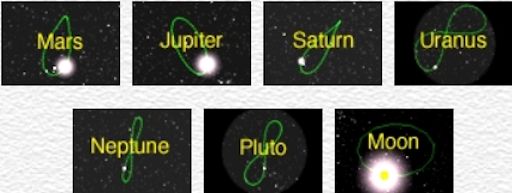
courtesy: analemma.com
Click here and scroll down to learn more about alien analemmas.
Realtime Space Weather Photo Gallery