LAST-MINUTE GIFT IDEA: Would you like to give someone a solar flare for Christmas? There's still time. Gift subscriptions to our Space Weather Alert Service are available now. Sign up for text or voice. Merry Christmas!
CHRISTMAS CONJUNCTION IN SPACE: According to some scholars, the Star of Bethlehem might have been a close encounter between Venus and Jupiter. The two brightest planets in the night sky, merged, would have made a spectacle of Biblical proportions. This Christmas, NASA's STEREO-B probe is observing a conjunction of three planets--Venus, Earth and Jupiter:

Unlike conjunctions of the distant past, this one includes our home planet. STEREO-B is located on the far side of the sun where it can look back and see Earth along with other worlds in the Solar System. Only NASA's twin STEREO probes, equipped with their high dynamic-range Heliospheric Imagers, can witness this kind of conjunction.
From STEREO-B's point of view, Earth and Jupiter are less than 0.4 degrees apart, while all three planets fit in a circle 2 degrees in diameter. This meeting is not nearly as tight as the putative Star of Bethlehem conjunction ~2000 years ago. At that time Venus and Jupiter could have been as little as 6 arcseconds (0.00166 degrees) apart. Nevertheless, the ongoing display is still special because it's the first "Christmas Star conjunction" from space. Happy Holidays from STEREO!
Realtime Space Weather Photo Gallery
CRESCENT VENUS: Wondering where to point that telescope you got for Christmas? Here's a target that will blow your holiday socks off: Venus. Like the Moon, Venus has phases, and at the moment it is a slender crescent. Maximilian Teodorescu sends this Christmas Eve photo from Targoviste, Romania:
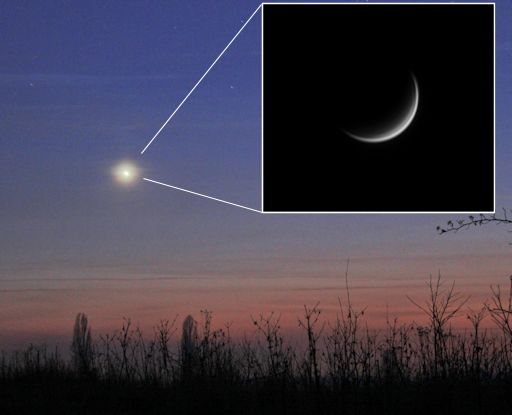
"I enjoyed another superb sunset with Venus dominating the southwestern sky," says Teodorescu. "The bright planet was visible even through cirrus clouds. Despite poor seeing conditions, the view through my refracting telescope was superb both at 30x and at 200x."
Every night the crescent grows thinner as Venus moves toward inferior conjunction with the sun in early January. Tonight, only 10% of the planet's illuminated hemisphere is visible from Earth. Because Venus is so thin, refraction in our atmosphere can produce a rainbow effect as colorful as any Christmas ornament. It really is a magical sight. More information is available from Sky and Telescope.