(ALMOST NO) CHANCE OF FLARES: Two sunspots facing Earth (AR1934 and AR1936) have 'beta-gamma' magnetic fields that harbor energy for strong flares. Both sunspots have been quiet for days, however, and they show no signs of an imminent eruption. This has prompted NOAA forecasters to place low odds on flares today: a 25% chance of M-flares and a 1% chance X-flares. Solar flare alerts: text, voice.
RADIO STORMS ON JUPITER: This week, there was a storm on Jupiter--a radio storm. Amateur radio astronomer Thomas Ashcraft recorded the event on Dec. 23rd using a shortwave radio telescope located in New Mexico. Click on the image to hear the whooshing, crackling, popping sounds that emerged from his telescope's loudspeaker:

Jupiter's radio storms are caused by natural radio lasers in the planet's magnetosphere that sweep past Earth as Jupiter rotates. Electrical currents flowing between Jupiter's upper atmosphere and the volcanic moon Io can boost these emissions to power levels easily detected by ham radio antennas on Earth. Jovian "S-bursts" (short bursts) and "L-bursts" (long bursts) mimic the sounds of woodpeckers, whales, and waves crashing on the beach. Here are a few audio samples: S-bursts, S-bursts (slowed down 128:1), L-Bursts
Now is a good time to listen to Jupiter's radio storms. The distance between Earth and Jupiter is decreasing as the giant planet approaches opposition on Jan. 5th; and the closer Jupiter comes, the louder it gets. Jupiter is a bit like a lighthouse. It is possible to predict when the planet's most intense radio beams will sweep past Earth. The next storm is due on Dec. 30th between 10:00 and 11:00 UT. NASA's Radio Jove Project explains how to build your own receiver.
Realtime Space Weather Photo Gallery
SOLAR WIND STREAM MISSES EARTH: A stream of solar wind expected to hit Earth's magnetic field on Dec. 26-27 has apparently missed, sailing mostly north of our planet. As a result, Earth's magnetic field is quiet and the polar auroral oval is dim. Another solar wind stream is coming, though, and it will likely reach Earth on Jan. 2-3, producing the first auroras of New Year. Arctic sky watchers could see something like this:

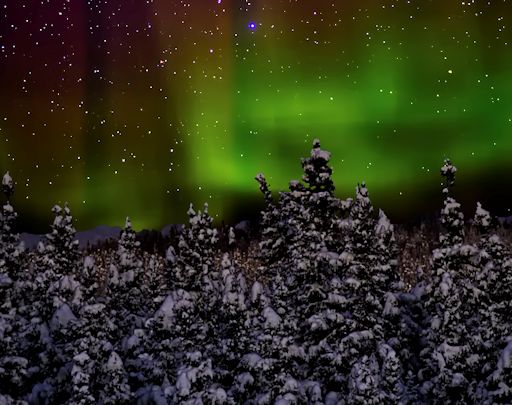
Nancy Dean of Sterling, Alaska, took the picture on Dec. 26th. "It was about 1:30 in the morning and -20 degrees outside when I got this photo," she says. At the time, the interplanetary magnetic (IMF) field near Earth had turned south, opening a crack in our planet's magnetosphere. Solar wind poured in and fueled the display. Aurora alerts: text, voice.