NEW YEARS AT THE EDGE OF SPACE: On New Year's Day, Jan. 1st, the students of Earth to Sky Calculus will launch a space weather balloon to the stratosphere (~120,000 feet altitude). It's part of their ongoing program to monitor energetic solar particles at the edge of space. Would you like to support their flight? You can! For only $49.95 the students will send a picture of your choice along for the ride. The group has previously photographed cupcakes, shoes, US presidents, ad banners and telescopes at the edge of space. Your personal New Year's greeting card could be next. Contact Dr. Tony Phillips for more information.


SIGNIFICANT FLARE: It could be the last solar flare of 2013. At 21:58 UT on Dec. 31st, sunspot AR1936 erupted and produced a strong M6-class solar flare. NASA's Solar Dynamics Observatory recorded the extreme ultraviolet flash:


A movie of the explosion shows a dark filament of plasma flying away from the blast site. Indeed, the explosion probably hurled a coronal mass ejection (CME) into space. The CME, if there is one, could deliver a glancing blow to Earth's magnetic field later this week. Stay tuned for updates as more data become available. Solar flare alerts: text, voice.
MUST-SEE SUNSET PHENOMENON: Like the Moon, Venus has phases, and this week it is a whisper-thin crescent. The phenomenon is easy to observe. Venus is so bright, you can see it at sunset even before the sky fades to black. To the naked eye, Venus looks like an unusually luminous star. A pair of binoculars or a small telescope reveals the planet's crescent shape.
This composite image shows how Venus looks to the naked eye and through a telescope:
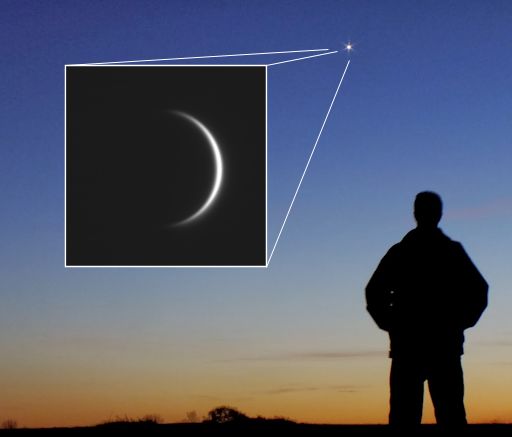
The sunset self-portrait was made by Jean-Baptiste Feldmann of Nuits-Saint-Georges, France. The telescopic inset was recorded by Sylvain Weiller of Saint Rémy-lès-Chevreuse, France. "The crescent is becoming very thin," says Weiller. "Venus no longer looks like a planet. It's more like a solar eclipse!"
Venus looks the way it does because it is turning its night side toward Earth. Today, only a 4% sliver of Venus's dayside is visible. On Jan. 11th, Venus will pass almost directly between Earth and the sun. At that moment, called "inferior conjunction," the sliver will almost completely disappear--so catch it now!
COMING SOON--THE FIRST AURORAS OF 2014: Magnetic fields in the sun's northern hemisphere have opened up, creating a vast hole in the sun's atmosphere--a coronal hole. NASA's Solar Dynamics Observatory is monitoring the UV-dark gap:

Coronal holes are places where magnetic fields threading through the sun's atmosphere spread apart and allow solar wind to escape. A stream of solar wind flowing from this particular coronal hole could reach Earth on Jan. 2-3, possibly sparking polar geomagnetic storms. The first auroras of 2014 are in the offing. Solar flare alerts: text, voice.
Realtime Space Weather Photo Gallery