NEW YEARS AT THE EDGE OF SPACE: On New Year's Day, Jan. 1st, the students of Earth to Sky Calculus will launch a space weather balloon to the stratosphere (~120,000 feet altitude). It's part of their ongoing program to monitor energetic solar particles at the edge of space. Would you like to support their flight? You can! For only $49.95 the students will send a picture of your choice along for the ride. The group has previously photographed cupcakes, shoes, US presidents, ad banners and telescopes at the edge of space. Your personal New Year's greeting card could be next. Contact Dr. Tony Phillips for more information.


STRONG FLARES UNDERWAY: 2014 began with a bang. At 18:54 UT on January 1st, big sunspot AR1936 erupted, producing a strong M9-class solar flare. This eruption follows close on the heels of an almost-equally strong M6-category explosion on New Year's Eve: movie. Here is a picture of the M9-flare recorded by NASA's Solar Dynamics Observatory:


Neither of the "New Year's Flares" so far have been very geoeffective. AR1936 is approaching the sun's western limb so it is not directly facing our planet. Nevertheless, CMEs produced by these explosions might deliver glancing blows to Earth's magnetic field later this week, possibly sparking geomagnetic storms. We'll find out more about this possibility when coronagraph data from SOHO and STEREO reach Earth.
Meanwhile, more flares are in the offing. Sunspot AR1936 has an unstable 'beta-gamma-delta' magnetic field that could erupt again at any time. NOAA forecasters estimate a 40% chance of M-class flares and a 10% chance of X-flares during the next 24 hours. Solar flare alerts: text, voice.
Realtime Space Weather Photo Gallery
NORTHERN LIGHTS: A medium-speed (~500 km/s) stream of solar wind is buffeting Earth's magnetic field, sparking auroras around the Arctic Circle. Last night, Darrell Jordan photographed the display from Ersfjordbotn, Norway:
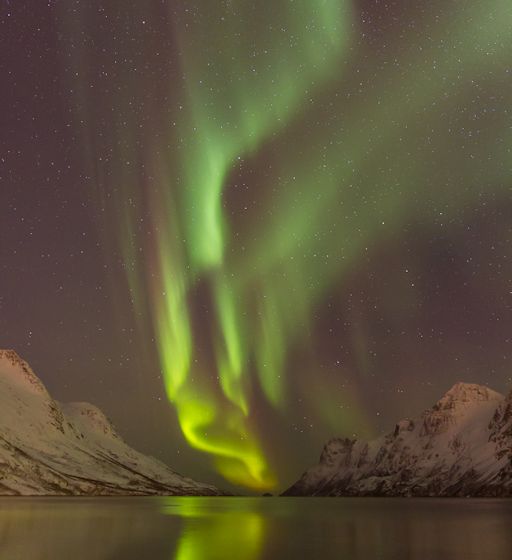
"What better way to spend New Years Eve than with clear skies and also an aurora display right up to 11.35pm?" says Jordan.
The display will likely spill over into the New Year. The solar wind speed is picking up as Earth moves deeper into the stream. NOAA forecasters estimate an increasing 25% to 40% chance of polar geomagnetic storms on Jan. 1-2. Aurora alerts: text, voice.