GEOMAGNETIC STORM: A minor (Kp=5) geomagnetic storm is in progress on Jan. 2nd in response to a solar wind stream, which is buffeting Earth's magnetosphere. High-latitude sky watchers should be alert for auroras. Aurora alerts: text, voice.
SUNSET CRESCENTS: When the sun sets tonight, step outside and look southwest. Not far above the horizon a super-slender crescent Moon is shining just above Venus. Look at Venus through a telescope--it's a crescent, too! Sylvain Weiller sends this picture of the pair from Saint Remy-les-Chevreuse, France:
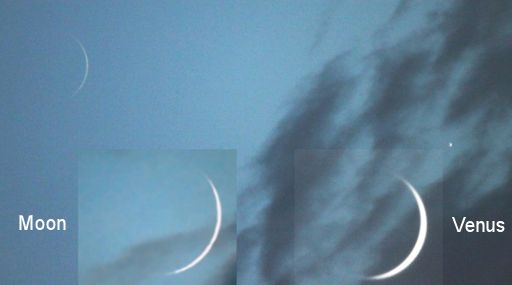
"What an incredible fractal show," says Weiller. "The Moon and Venus now have exactly the same shape, a very thin crescent, albeit visually of completely different size!" Browse the gallery for more:
SOLAR ACTIVITY UPDATE: 2014 began with a bang. At 18:54 UT on January 1st, big sunspot AR1936 erupted, producing a strong M9-class solar flare. NASA's Solar Dynamics Observatory captured the explosion's extreme ultraviolet flash:

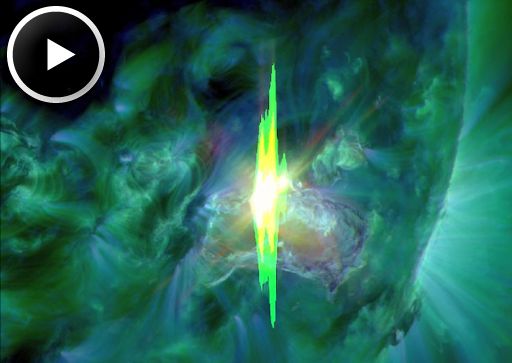
The movie shows a dark filament of plasma racing away from the blast site, but most of the material fell back to the stellar surface. Nevertheless, the explosion did produce a CME that could deliver a glancing blow to Earth's magnetic field later this week. NOAA analysts are still evaluating this possibility.
The M9-flare of New Year's Day followed close on the heels of an M6-flare on New Year's Eve. Sunspot AR1936 produced both explosions. The New Year's Eve event produced a minor, slow-moving CME that is not expected to disturb Earth's magnetic field if and when it does arrive.
Sunspot AR1936 is active, but new sunspot AR1944 looks even more potent. The behemoth active region emerged over the sun's southeastern limb on Jan 1st:

Because of foreshortening near the sun's limb, the complexity of AR1944's magnetic field is still unknown. The sheer size of the sunspot, however, suggests it is capable of strong flares. The emergence of AR1944 combined with the ongoing activity from AR1936 has prompted NOAA forecasters to raise the odds of eruptions on Jan. 2nd to 70% for M-flares and 30% for X-flares. Solar flare alerts: text, voice.
Realtime Space Weather Photo Gallery
FIRST AURORAS OF 2014: A solar wind stream is buffeting Earth's magnetic field, sparking the first auroras of 2014. Tour guide Peter Rosén photographed the New Year's display from Abisko National Park in the Swedish Lapland:
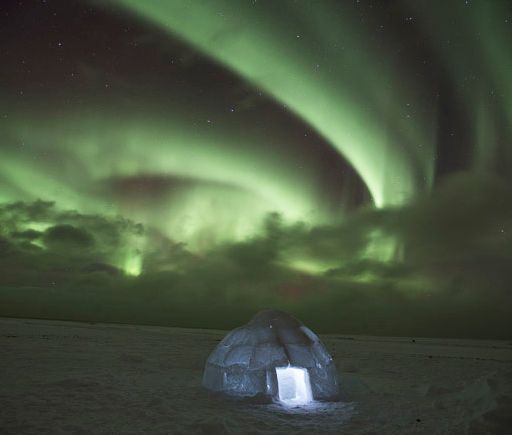
"This was our first night at our new ice igloo camp in Abisko National Park--and what a night!" says Rosén. "Me, my 2 new photo guides Ylva and Anette, and 11 guests from all over the world got to see the most incredible auroras. And when Ylva Sarri started to sing a traditional Sámi jojk about the wind while we were sitting next to the fire, I think I was not the only one who experienced an almost religious feeling. I hope this is a good sign for the rest of 2014."
The second auroras of the New Year are likely tonight. NOAA forecasters estimate a 40% chance of polar geomagnetic storms on Jan. 2nd as the solar wind continues to blow. Aurora alerts: text, voice.