INCOMING CME: A CME is heading toward Earth. The incoming cloud (movie) was hurled into space by an M4-class explosion from sunspot AR1944 on Jan. 4th and is expected to deliver a glancing blow to our planet's magnetic field on Jan. 7th. Minor to moderate geomagnetic storms are possible when the CME arrives. Aurora alerts: text, voice.

RADIATION STORM IN PROGRESS: Energetic solar protons are streaming past Earth today, triggering an S1-class solar radiation storm. They were propelled toward us by an explosion in the magnetic canopy of old sunspot AR1936. The Solar and Heliospheric Observatory recorded the blast:

Play the movie again. The snowy speckles dancing around the image are caused by energetic protons striking the coronagraph's digital camera. They are a sign that a radiation storm is underway.
Although this radiation storm is classified as S1, that is, minor, it is fairly rich in high energy particles that can temporarily "snow" (degrade the performance of) space-based cameras. NOAA forecasters expect the storm to continue for another day or so. Stay tuned for updates. Solar flare alerts: text, voice.
Realtime Space Weather Photo Gallery
GIANT SUNSPOT TURNS TOWARD EARTH: Watch this movie. One of the largest sunspots in years is turning toward Earth: AR1944 has a 'beta-gamma-delta' magnetic field that harbors energy for potent eruptions. NOAA forecasters estimate a 75% chance of M-class flares and a 30% chance of X-flares on Jan. 6th. Any flares today will almost certainly be geoeffective.

AR1944 contains dozens of dark cores, the largest of which is big enough to swallow three planet Earths. It's so big, sky watchers are noticing it as a blemish on the solar disk at sunset:
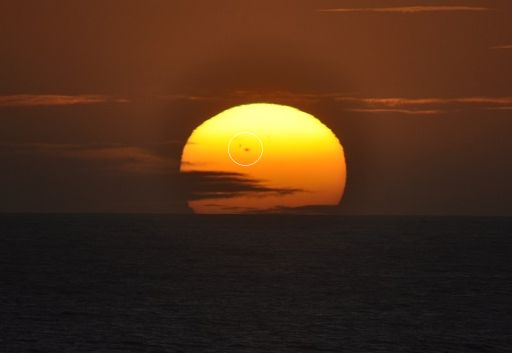
"Sunspot AR1944 was visible without using a solar telescope," reports Eddie Irizarry of Rincon, Puerto Rico, who took this picture at the end of the day on Jan. 5th. "Proper filters and extreme care should be taken when photographing the sun," he adds. "Unfiltered sunlight magnified by optics can cause serious eye damage."
Astronomers who have a safe solar telescope are encouraged to take a closer look. "AR1944 has to be the most awesome sunspot ever," says Sergio Castillo of Inglewood, CA. "I cannot stop photographing it." Here is his latest image from Jan. 5th:
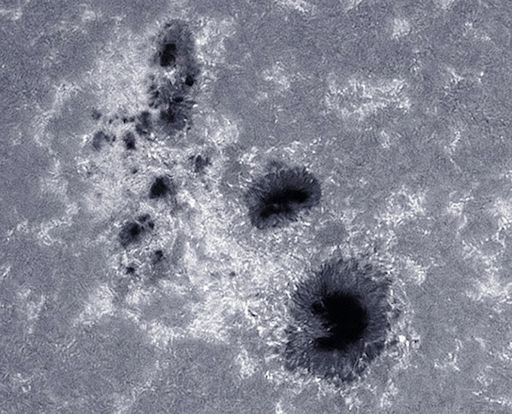
Castillo used a telescope capped with a "Calcium K" filter. Calcium K filters, which are sensitive to the blue glow of calcium ions in the sun's lower atmosphere, highlight the bright magnetic froth that often forms around a sunspot's dark cores. AR1944 is very frothy indeed.
Magnetic froth does not necessarily herald an explosion, but it does guarantee a photogenic sunspot. Scan the gallery for more images:
Realtime Space Weather Photo Gallery
VENUS, THE CRESCENT PLANET: Venus is turning its night side toward Earth as it approaches inferior solar conjunction on Jan. 11th. Barely 1% of Venus's sunlit hemisphere is now facing us, which means the planet looks like a razor-thin crescent. If you have a GOTO telescope, command it to slew to Venus. It's visible even in broad daylight:
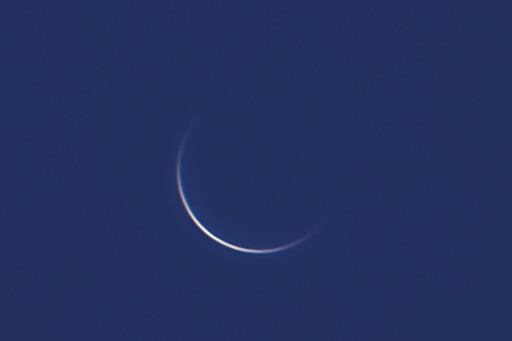
Shahrin Ahmad of Sri Damansara, Malaysia, took the picture on Jan. 6th using a 4.5 inch telescope. "As Venus gets closer to the sun, it gets thinner everyday!" says Ahmad. "So far, this is the thinnest Venus I've managed to photograph--a mere 9.5o from the sun and just 1.3% illuminated!"