X-FLARE: Giant sunspot AR1944 erupted on Jan 7th at approximately 1832 UT, producing a powerful X1-class solar flare. First-look coronagraph images from the STEREO-Ahead spacecraft appear to show a coronal mass ejection (CME) emerging from the blast site. If so, the CME is almost certainly heading for Earth. Stay tuned for updates as more data arrive from the NASA-ESA Heliophysics Fleet. Solar flare alerts: text, voice.
HUGE SUNSPOT TARGETS EARTH: One of the biggest sunspots in years is crossing the center of the solar disk, putting Earth in the way of potential eruptions. Rocky Raybell photographed the active region named "AR1944" yesterday from his backyard in Keller, Washington:

The sprawling sunspot contains dozens of dark cores, the largest big enough to swallow Earth three times over. This makes it an easy target for amateur solar telescopes -- or even regular cameras. Raybell used an SX40 digital camera on a tripod whole holding a Baader solar filer over the lens to capture his image. Photo details may be found here.
Although AR1944 has been mostly quiet for days, flares are in the offing. The sunspot has an unstable 'beta-gamma-delta' magnetic field that could erupt at any time. NOAA forecasters estimate a 75% chance of M-class flares and a 30% chance of X-flares on Jan. 7th.

Above: A 4-day movie of AR1944 from the Solar Dynamics Observtory
Realtime Space Weather Photo Gallery
CME IMPACT: A coronal mass ejection (CME) hit Earth's magnetic field on Jan. 7th at approximately 1500 UT. The glancing impact did not immediately spark a geomagnetic storm. However, storm conditions could develop as Earth travels through the CME's wake. High latitude sky watchers should remain alert for auroras. Aurora alerts: text, voice.
VENUS, THE CRESCENT PLANET: Venus is turning its night side toward Earth as it approaches inferior solar conjunction on Jan. 11th. Barely 1% of Venus's sunlit hemisphere is now facing us, which means the planet looks like a razor-thin crescent. If you have a GOTO telescope, command it to slew to Venus. It's visible even in broad daylight:
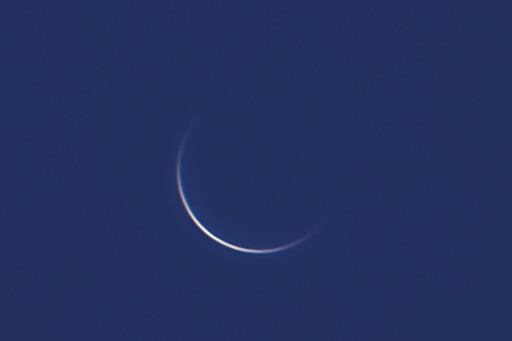
Shahrin Ahmad of Sri Damansara, Malaysia, took the picture on Jan. 6th using a 4.5 inch telescope. "As Venus gets closer to the sun, it gets thinner everyday!" says Ahmad. "So far, this is the thinnest Venus I've managed to photograph--a mere 9.5o from the sun and just 1.3% illuminated!"