GROWING QUIET? Giant sunspot AR1944 has not unleashed a significant flare in more than 48 hours. The growing quiet could be the calm between storms. AR1944 has an unstable 'beta-gamma-delta' magnetic field that harbors energy for X-class flares. Solar flare alerts: text, voice.
CME IMPACT: As predicted, a CME hit Earth's magnetic field on Jan. 9th (20:00 UT). The impact was weaker than expected, however, and it failed to produce widespread geomagnetic storms. Nevertheless, some beautiful auroras appeared around the Arctic Circle. Harald Albrigtsen sends this picture from Tromsø, Norway:
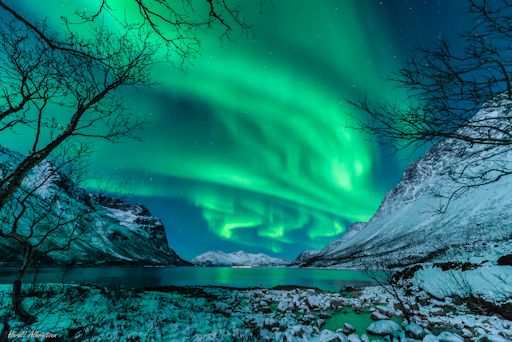
It was dark in Norway when the CME arrived, so observers there witnessed a nice display. By the time night fell over North America, however, the lights had faded. US observers saw nothing remarkable.
More auroras are possible on Jan. 10th as Earth passes through the magnetic wake of the CME. NOAA forecasters estimate a 85% chance of polar geomagnetic storms before the day is over. Aurora alerts: text, voice.
SPACE WEATHER BALLOON UPDATE: The payload of a space weather balloon launched Jan. 8th by the students of Earth to Sky Calculus has been recovered from its landing site in Death Valley National Park. The purpose of the flight was to study a solar radiation storm in progress at the time of the launch. Analyzing the data may take a few days. Meanwhile, here is the view from the stratosphere:
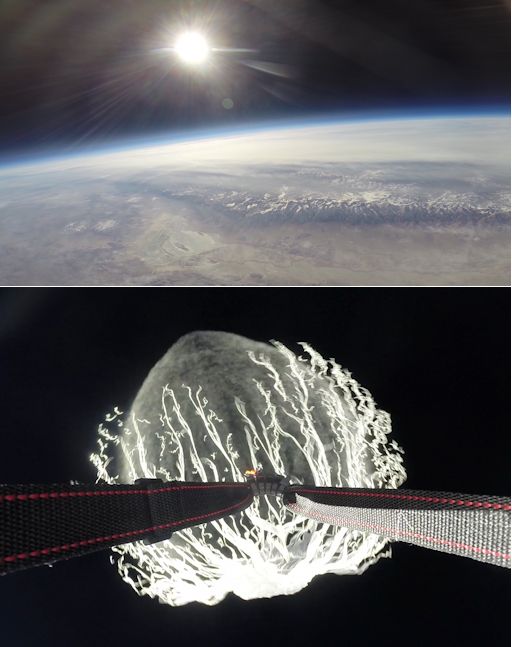
These pictures were taken by a pair of Hero3+ cameras looking out of the payload capsule. The upper frame shows the Sierra Nevada mountain range, unusually brown for this time of year as California endures a historic drought. The lower frame captures the balloon popping at an altitude of approximately 100,000 feet. Click on each frame for a closer look. The landscape shot was made using the Hero3+'s new "superview mode"--a favorite of snowboarders and now, for the first time, balloonists!
In addition to cameras, the payload contained an x-ray/gamma-ray dosimeter, a GPS altimeter, and a cryogenic thermometer. Together these instruments can form a complete thermal and radiation profile of the atmosphere throughout the flight. The students plan to pay special attention to data collected at aviation altitudes to learn how much radiation air travelers absorb during periods of high solar activity. Solar flare alerts: text, voice.
Realtime Space Weather Photo Gallery