CHANCE OF FLARES: NOAA forecasters estimate a 35% chance of X-class solar flares on Jan. 11th, most likely from AR1944. The brooding sunspot has been quiet for days, but still poses a threat for strong eruptions. Solar flare alerts: text, voice.
VENUS AT INFERIOR CONJUNCTION: Today, Jan. 11th, Venus is at inferior conjunction. That means it is passing almost directly between Earth and the sun. With its nightside facing Earth (almost perfectly), Venus looks like an incredibly slender crescent. This morning in Targoviste, Romania, amateur astronomer Maximilian Teodorescu photographed Venus only 5 degrees from the sun:

"Taking extreme care not to point any unfiltered optics at the sun, I started to look for Venus through my 11-inch Celestron telescope," says Teodorescu. "The thin but very large crescent suddenly appeared into the field of view. It was surreal to watch the boiling atmospheric arc of the planet just above the sun in plain day. My wife immortalized the moment by taking a panoramic view from our clear-sky location."

Observing Venus through a telescope can be dangerous. Even a quick inadvertent glimpse of magnified light from the nearby sun can cause serious eye damage. Anthony J. Cook of the Griffith Observatory has some advice for observers: "I have observed Venus at conjunction, but only from within the shadow of a building, or by adding a mask to the front end of the telescope to fully shadow the optics from direct sunlight. This is tricky with a refractor or a catadioptric, because the optics start at the front end of the tube. Here at Griffith Observatory, I rotate the telescope dome to make sure the lens of the telescope is shaded from direct sunlight, even through it means that the lens will be partially blocked when aimed at Venus. With our Newtonian telescope, I add a curved cardboard mask at the front end of the tube to shadow the primary mirror."
Around the world, many people are applying these techniques to photograph Venus as it passes by the sun. Browse the gallery to see their amazing results:
SPACE WEATHER BALLOON UPDATE: The payload of a space weather balloon launched Jan. 8th by the students of Earth to Sky Calculus has been recovered from its landing site in Death Valley National Park. The purpose of the flight was to study a solar radiation storm in progress at the time of the launch. Analyzing the data will take a few days. Meanwhile, here is the view from the stratosphere:
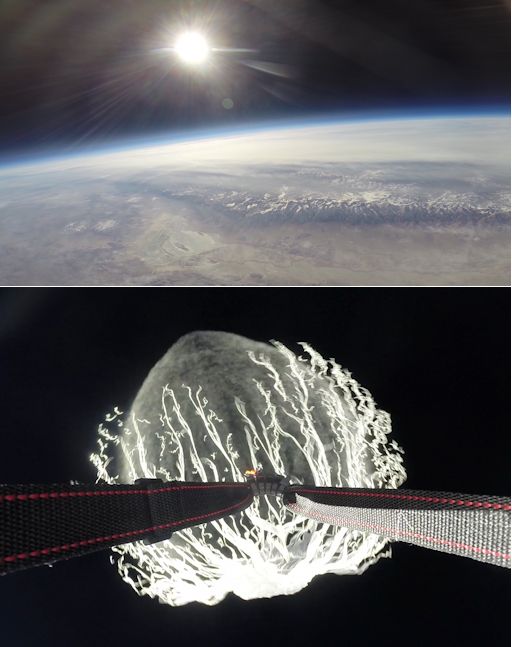
These pictures were taken by a pair of Hero3+ cameras looking out of the payload capsule. The upper frame shows the Sierra Nevada mountain range, unusually brown for this time of year as California endures a historic drought. The lower frame captures the balloon popping at an altitude of approximately 100,000 feet. Click on each frame for a closer look. The landscape shot was made using the Hero3+'s new "superview mode"--a favorite of snowboarders and now, for the first time, balloonists!
Update: Here are some more images from tthe flight: A sundog over Owens Valley, Death Valley from the Edge of Space, Coyote Flats.


In addition to cameras, the payload contained an x-ray/gamma-ray dosimeter, a GPS altimeter, and a cryogenic thermometer. Together these instruments can form a complete thermal and radiation profile of the atmosphere throughout the flight. The students plan to pay special attention to data collected at aviation altitudes to learn how much radiation air travelers absorb during periods of high solar activity. Solar flare alerts: text, voice.
Realtime Space Weather Photo Gallery