JUPITER AND THE MOON: When the sun goes down tonight, step outside and look east. The waxing full Moon is approaching Jupiter for a close encounter on Jan. 14th. The two brightest objects in the evening sky are easy to see even from urban areas with strong light pollution. Backyard astronomy alerts: text, voice.
FAST SOLAR WIND: Blowing with gusts as fast as 800 km/s (1.8 million mph), a stream of solar wind is buffeting Earth's magnetic field. Because the density of the stream is so low, it is not causing strong geomagnetic storms. Nevertheless, some bright auroras have appeared around the Arctic Circle:

Asko Aikkila sends this picture from Kuusamo, Finland. "Last night when I was going to sleep, I looked through the bedroom window and saw silent auroras dancing in the moon light. I snapped the picture right through the window. It was a very pleasant way to experience the Northern Lights."
Arctic sky watchers should remain alert for auroras on Jan. 13-14 as the solar wind continues to blow. Aurora alerts: text, voice.
CYGNUS AND THE ISS: On Jan. 12th, a robotic arm on the ISS reached out and snagged another spaceship--Orbital Sciences Corporation's Cygnus cargo carrier. Cygnus reached the ISS on time despite a launch delay last Wednesday caused by stormy space weather. The docking on Sunday morning at 8:05 am EST marked the first successful contracted cargo delivery by Orbital Sciences.
Only five hours before docking, the two spacecraft flew over the Netherlands where veteran satellite observer Marco Langbroek was waiting with his camera to take this picture:

"The Cygnus cargoship was too faint to be seen by the naked eye for most of the pass, but around 5:57:05 UTC it briefly flared to mag +2 and the close duo ISS-Cygnus was suddenly and briefly well visible as a result," says Langbroek. "This picture shows the moment when the Cygnus flared."
Cygnus delivered almost 2800 lbs of equipment and crew supplies to the space station. This includes dozens of new science experiments including 23 designed by students. One newly arrived investigation will study the behavior of ants in microgravity. Another will probe the decreased effectiveness of antibiotics during spaceflight--a possible problem for astronauts on long space journeys. Yet another will explore how different materials burn in microgravity to improve fire safety in future spacecraft. More information is available from NASA.
Realtime Space Weather Photo Gallery
SPACE WEATHER BALLOON UPDATE: The payload of a space weather balloon launched Jan. 8th by the students of Earth to Sky Calculus has been recovered from its landing site in Death Valley National Park. The purpose of the flight was to study a solar radiation storm in progress at the time of the launch. Analyzing the data will take a few days. Meanwhile, here is the view from the stratosphere:
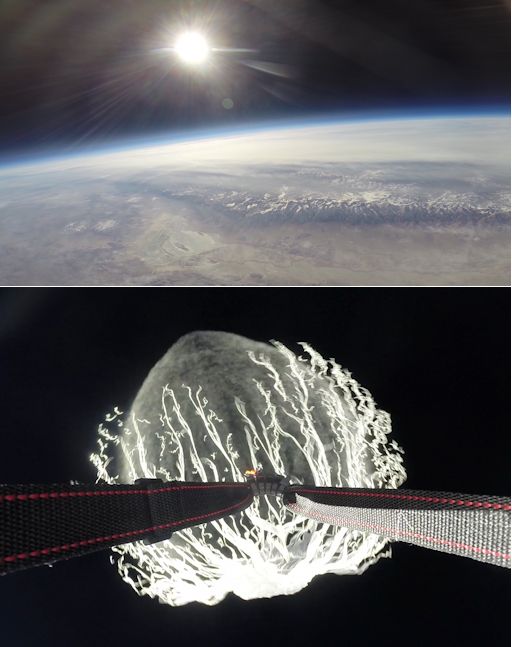
These pictures were taken by a pair of Hero3+ cameras looking out of the payload capsule. The upper frame shows the Sierra Nevada mountain range, unusually brown for this time of year as California endures a historic drought. The lower frame captures the balloon popping at an altitude of approximately 100,000 feet. Click on each frame for a closer look. The landscape shot was made using the Hero3+'s new "superview mode"--a favorite of snowboarders and now, for the first time, balloonists!
Update: Here are some more images from tthe flight: A sundog over Owens Valley, Death Valley from the Edge of Space, Coyote Flats.


In addition to cameras, the payload contained an x-ray/gamma-ray dosimeter, a GPS altimeter, and a cryogenic thermometer. Together these instruments can form a complete thermal and radiation profile of the atmosphere throughout the flight. The students plan to pay special attention to data collected at aviation altitudes to learn how much radiation air travelers absorb during periods of high solar activity. Solar flare alerts: text, voice.
Realtime Space Weather Photo Gallery