MOSTLY QUIET WITH A CHANCE OF FLARES: For the past 24 hours, solar activity has been low. However, two sunspots facing Earth, AR1957 and AR1959, have 'beta-gamma' magnetic fields that harbor energy for M-class solar flares. NOAA forecasters estimate a 30% chance of M-flares on Jan. 22nd. Solar flare alerts: text, voice.
SUPERNOVA! Approximately 12 million years ago, a white dwarf star in the galaxy M82 exploded. This week, light from the distant supernova reached Earth. Amateur astronomers can easily see it through backyard telescopes as a fireball of magnitude +11.2, shown here in a photo taken by Leonard Ellul-Mercer on Jan. 22nd:
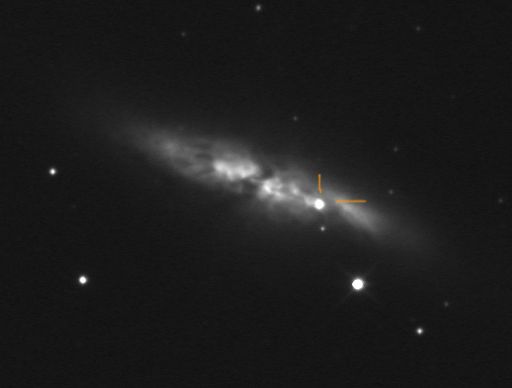
Although it is 12 million light years away, M82 is considered to be a next-door neighbor of the Milky Way. Indeed, this is the nearest supernova to Earth since SN 1993J exploded 21 years ago. The relative proximity of the blast makes it an attractive target for astronomers to study. Light curves from previous supernovas of this type suggest that the fireball could continue to brighten for the next two weeks.
If you have a GOTO telescope, this evening command it to slew to the "cigar galaxy" or "M82," and watch the explosion unfold.
Realtime Space Weather Photo Gallery
ARCTIC LIGHTS: Earth is entering a stream of solar wind blowing faster than 500 km/s (1.1 million mph), and this is sparking auroras around the Arctic Circle. Just after nightfall on Jan. 21st, Harald Albrigtsen photographed the display over Kvaløya, Tromsø, Norway:
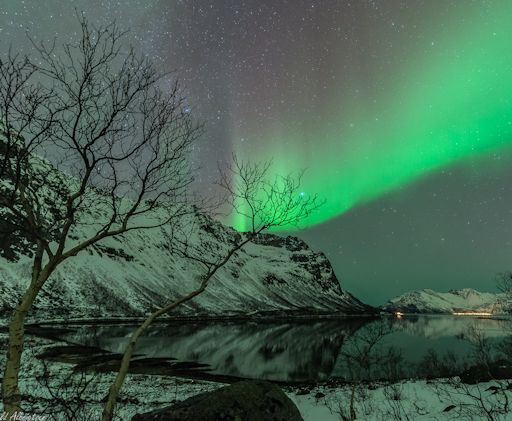
"I caught the auroras just before the clouds arrived," says Albrigtsen, "so it was a lucky shot."
More lucky shots are possible on Jan. 23 when a CME is expected to deliver a glancing blow to Earth's magnetic field, adding to the effect of the solar wind stream already here. NOAA forecasters estimate a 25% chance of polar geomagnetic storms. Aurora alerts: text, voice.
FASCINATING PHENOMENA OF JUPITER'S MOONS: On Jan. 5th, Earth passed directly between the sun and Jupiter. Astronomers call this an "opposition" because the sun and Jupiter were on opposite sides of the sky. "Jupiter's opposition is always an opportunity for beautiful pictures of moons transiting Jupiter, sometimes directly in front of their own shadows," says John H. Rogers, Jupiter Section Director of the British Astronomical Association. "Observers have produced some fine examples from the opposition earlier this month." Some of the best are collected here:

Transits around opposition are beautiful, but something even more rare and special is coming this fall. "In autumn, Jupiter's moons will begin a series of mutual eclipses and occultations," Rogers says. The satellites will criss-cross in the sky, dipping in and out of one another's shadows. Predictions by Jean Meeus have been posted by the British Astronomical Association Computing Section at these URLs. "The last time these mutual events occurred, in 2009, observers were able to produce the first high-resolution movies of moons eclipsing moons. No doubt some of you will be able to do even better this time around." Stay tuned!
Realtime Space Weather Photo Gallery