CHANCE OF STORMS: NOAA forecasters estimate a 25% chance of polar geomagnetic storms on Jan. 23rd in response to a glancing blow from a CME. High-latitude sky watchers should be alert for midnight auroras. Aurora alerts: text, voice
SUPERNOVA! Approximately 12 million years ago, a white dwarf star in the galaxy M82 exploded. This week, light from the distant supernova finally reached Earth. Amateur astronomers can see it through backyard telescopes as a fireball of magnitude +11.2 in one of the galaxy's dusty spiral arms. Here is the view through an 8-inch telescope on Jan. 22nd:
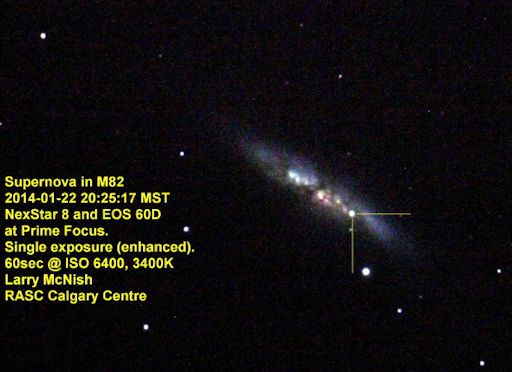
Larry McNish took the picture from the University of Calgary's Rothney Astrophysical Observatory in Alberta, Canada. "I used a Canon 60D DSLR at the prime focus of an 8 inch Celestron SCT telescope," he says. "This is just a single exposure of 60 seconds at ISO 6400 using a white balance of 3400K to reduce the sodium sky glow from Calgary."
Although it is 12 million light years away, M82 is considered to be a next-door neighbor of the Milky Way. Indeed, this is the nearest supernova to Earth since SN 1993J was famously observed 21 years ago. The relative proximity of the blast makes it an attractive target for astronomers to study. Light curves from previous supernovas of this type suggest that the fireball could continue to brighten for the next two weeks.
If you have a GOTO telescope, this evening command it to slew to the "cigar galaxy" or "M82," and watch the explosion unfold.
Realtime Supernova Photo Gallery
FASCINATING PHENOMENA OF JUPITER'S MOONS: On Jan. 5th, Earth passed directly between the sun and Jupiter. Astronomers call this an "opposition" because the sun and Jupiter were on opposite sides of the sky. "Jupiter's opposition is always an opportunity for beautiful pictures of moons transiting Jupiter, sometimes directly in front of their own shadows," says John H. Rogers, Jupiter Section Director of the British Astronomical Association. "Observers have produced some fine examples from the opposition earlier this month." Some of the best are collected here:

Transits around opposition are beautiful, but something even more rare and special is coming this fall. "In autumn, Jupiter's moons will begin a series of mutual eclipses and occultations," Rogers says. The satellites will criss-cross in the sky, dipping in and out of one another's shadows. Predictions by Jean Meeus have been posted by the British Astronomical Association Computing Section at these URLs. "The last time these mutual events occurred, in 2009, observers were able to produce the first high-resolution movies of moons eclipsing moons. No doubt some of you will be able to do even better this time around." Stay tuned!
Realtime Space Weather Photo Gallery