MOSTLY QUIET WITH A CHANCE OF FLARES: With no sunspots actively flaring, solar activity is low. However, sunspots AR1957 and AR1959 could break the quiet. Both regions have 'beta-gamma' magnetic fields that harbor energy for medium-sized eruptions. NOAA forecasters estimate a 15% chance of M-class flares on Jan. 24th. Solar flare alerts: text, voice
SPACE WEATHER BALLOON LAUNCH THIS WEEKEND: The students of Earth to Sky Calculus will be launching another space weather balloon on Jan. 25th. This is the latest in a series of missions designed to study the effects of solar activity on Earth's upper atmosphere. Their previous mission on January 8th flew into the teeth of an S2-class solar radiation storm. Here are the data they gathered during the flight:

During the balloon's ascent, an onboard x-ray/gamma-ray sensor measured radiation doses 25 times greater than that at the Sierra Nevada launch site. The peak occured at the entrance to the stratosphere in a zone known as the "Pfotzer Maximum." Named after physicist George Pfotzer, who discovered the peak using balloons and Geiger tubes in the 1930s, the Pfotzer Maximum is produced by energetic particles hitting Earth's atmosphere, creating a spray of subatomic debris at high altitudes. The Earth to Sky balloon flights aim to find out how the Pfotzer Maximum moves around in response to solar storms.
This weekend's flight will repeat the experiment using the same equipment while no solar radiation storm is in progress. If all goes well, the balloon will also capture dramatic images of California's epic drought. Stay tuned for updates.
NO CME, NO PROBLEM: A CME expected by forecasters to deliver a glancing blow to Earth's magnetic field on Jan. 23rd missed our planet. Arctic sky watchers got an eye-full anyway. Dennis Ball sends this picture of colors erupting last night over Bolungarvik, Iceland:

"After a day of horrid weather, the clouds parted at 9 PM and I grabbed by camera to photograph the auroras," says Ball. "By 10.30 PM the clouds had rolled in again, so I got an early night. It was an excellent start to my Iceland trip."
The source of the display was not a CME, but rather a fluctuation in the interplanetary magnetic field or "IMF." On Jan. 23rd, the IMF tilted south for a few hours, opening a crack in Earth's magnetosphere. Solar wind poured in to fuel the auroras. Aurora alerts: text, voice
SUPERNOVA! Approximately 12 million years ago, a white dwarf star in the galaxy M82 exploded. This week, light from the distant supernova finally reached Earth. Amateur astronomers can see it through backyard telescopes as a fireball of magnitude +11.2 in one of the galaxy's dusty spiral arms. Here is the view through an 8-inch telescope on Jan. 22nd:
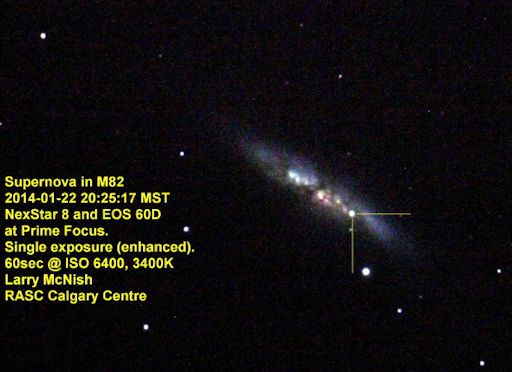
Larry McNish took the picture from the University of Calgary's Rothney Astrophysical Observatory in Alberta, Canada. "I used a Canon 60D DSLR at the prime focus of an 8 inch Celestron SCT telescope," he says. "This is just a single exposure of 60 seconds at ISO 6400 using a white balance of 3400K to reduce the sodium sky glow from Calgary."
Although it is 12 million light years away, M82 is considered to be a next-door neighbor of the Milky Way. Indeed, this is the nearest supernova to Earth since SN 1993J was famously observed 21 years ago. The relative proximity of the blast makes it an attractive target for astronomers to study. Light curves from previous supernovas of this type suggest that the fireball could continue to brighten for the next two weeks.
If you have a GOTO telescope, this evening command it to slew to the "cigar galaxy" or "M82," and watch the explosion unfold.
Realtime Supernova Photo Gallery
Realtime Space Weather Photo Gallery