SLIGHT CHANCE OF FLARES: Northern sunspot AR1957 has a 'beta-gamma' magnetic field that harbors energy for M-class solar flares. The region's persistant quiet, however, suggests the odds of an eruption are low. NOAA forecasters estimate a 15% chance of M-flares on Jan. 26th. Solar flare alerts: text, voice
SPACE WEATHER BALLOON, LAUNCHED AND RECOVERED: Yesterday, the students of Earth to Sky Calculus launched a suborbital helium balloon from Bishop, California, and recovered the payload hours later from a nearby canyon. The goal of the mission was to measure high-energy radiation levels in the stratosphere. Those data are being reduced now. The students also captured panoramic images of California's epic drought:

So much for the Golden State. The landscape of California is remarkably brown as the driest winter in more than a century unfolds. The drought is so bad that the city of Bishop, where the students go to school, looks like a settlement on the planet Mars: image.

"Up and down California, from Oregon to Mexico, it's dry as a bone," comments JPL climatologst Bill Patzert. "To make matters worse, the snowpack in the water-storing Sierras is less than 20% of normal for this time of the year."
Indeed, the towering Sierras, only sparsely covered by crusty month-old snow, lack their usual white reflectance in many of the group's edge of space photos. Not much water will be flowing from those peaks to urban areas when the snow melts in spring. Water rationing and wildfires are likely this summer.
On the bright side, launching the balloon was lots of fun! Stay tuned for updates as the radiation data are analyzed.
Realtime Space Weather Photo Gallery
BRIGHT, NEARBY SUPERNOVA: Approximately 12 million years ago, a white dwarf star in galaxy M82 exploded. A few days ago, light from the supernova finally reached Earth. Amateur astronomers can see it through backyard telescopes as a fireball of magnitude +11. Indeed, it is so bright that small telescopes can be used to study the specturm of the blast. David Strange sends these data from Branscombe, East Devon, UK:
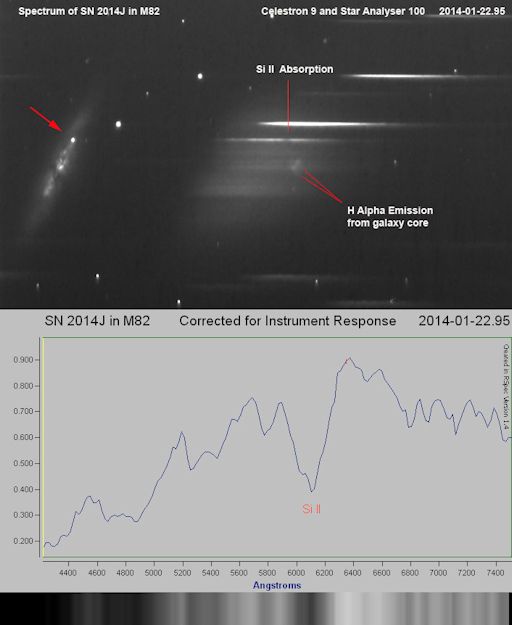
"I used a 9-inch Celestron telescope and a Star Analyzer 100 to record the supernova's colors," says Strange.
His data show a strong absorption line corresponding to ionized silicon. Silicon is one of the products of fusing carbon and oxygen, and a telltale sign that this is a Type 1a supernova explosion. Type 1a supernovas are famous in part because they led to the discovery of Dark Energy in the universe. (And, yes, we know that "Dark Energy" is shorthand for "we don't know what's going on.")
Although it is 12 million light years away, M82 is considered to be a next-door neighbor of the Milky Way. Indeed, this is the nearest supernova to Earth since SN 1993J was observed 21 years ago. The relative proximity of the blast makes it an attractive target for astronomers to study. Light curves from previous Type 1a supernovas suggest that the fireball could continue to brighten for the next two weeks. If you have a GOTO telescope, this evening command it to slew to the "cigar galaxy" or "M82," and watch the explosion unfold.
Realtime Supernova Photo Gallery