STRONG M-FLARE AND CME: Yesterday, Jan. 30th, big sunspot AR1967 unleashed a strong M6-class solar flare. The explosion sent a CME racing away from the blast site faster than 1400 km/s (3 million mph): movie. The cloud appears to have an Earth-directed component, and could deliver a glancing blow to our planet's magnetic field on Feb 1st. Aurora alerts: text, voice

LUNAR TRANSIT OF THE SUN: On Jan. 30th, the Moon passed almost directly in front of the sun. No darkness fell on Earth, however, because the "lunar transit" was only visible from space. NASA's Solar Dynamics Observatory (SDO) recorded the entire passage from geosynchronous orbit:

At maximum eclipse as much as 90% of the sun was covered. SDO is solar powered, but it did not "brown out" because mission controllers put an extra charge on the spacecraft's batteries ahead of time. Every year, SDO observes multiple lunar transits. This one, lasting almost 2.5 hours, was the longest in the history of the spacecraft's 4 year mission.
A highlight of the movie occurs just after the eclipse is finished when sunspot AR1967 erupts. A plume of hot plasma flies away from one side of the sun just as the Moon is exiting the other. That eruption is the source of the CME that could deliver a glancing blow to Earth's magnetic field on Feb. 1st.
Realtime Space Weather Photo Gallery
DIAMOND DUST SKI HALO: Ski resorts are one of the best places to see sun halos--rings of light that surround the sun when ice crystals fill the air. The most sublime halos are caused by jewel-like crystals called "diamond dust." On Jan. 29th, Christian Schartner was skiing in Obertauern, Austria, when he witnessed this specimen:
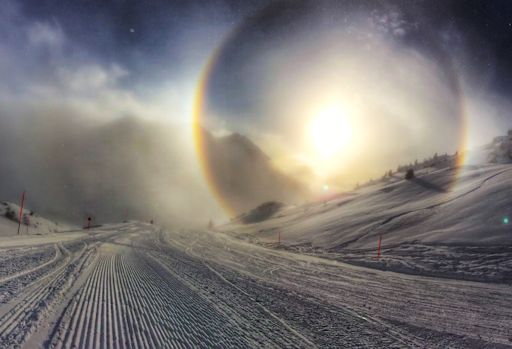
"The outside temperature was quite chilly at -12°C when we hit the slopes," says Schartner. "Beautiful sun halos made our skiing day even better!"
Most sun halos are caused by ice crystals floating high above Earth's surface in cirrus clouds. "Ski halos," on the other hand, are formed by ice crystals near the ground, kicked into the air by the action of skis and snow-making machines. A close look at Schartner's picture shows specks of light in the air. Those are the glittering crystals of diamond dust which make these halos so beautiful.

If you're on the slopes this weekend, and the sun dips behind a cloud of ice, be alert for "ski halos." They can make your day.