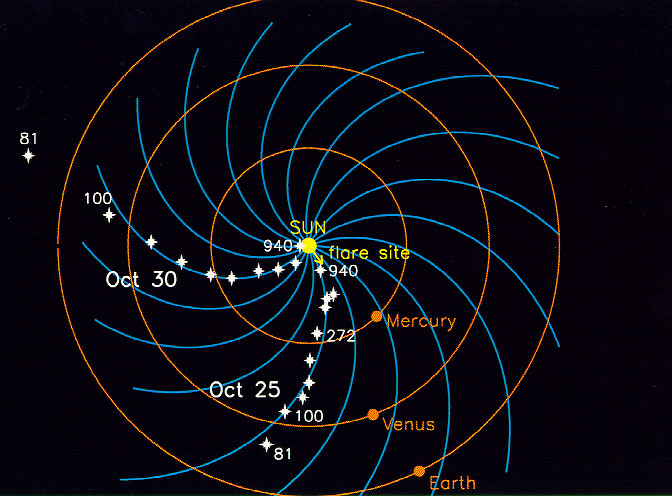
GOOD-BYE SUNSPOTS, HELLO RADIATION STORM?: Today, big sunspots AR1967 and AR1968 are rotating over the sun's western limb to begin a two-week transit of the sun's farside. Ironically, this could result in elevated levels of radiation near Earth. At their current location, the two sunspots are well-connected to our planet by the sun's spiraling magnetic field. Any flares today could funnel energetic particles in our direction, possibly triggering a radiation storm. Solar flare alerts: text, voice
MAGNETIC UNREST: Earth's magnetic field is still reverberating from the impact of a CME on Feb. 7th. Intermittent storming around the poles has produced bright auroras across Scandinavia, Iceland and Canada. Zoltan Kenwell sends this picture from Edmonton, Alberta:

"I was driving home when I noticed a dim green blob on the eastern horizon," says Kenwell. "I pulled off the highway for a better look and, to my surprise, I saw this corona dancing right above me.
The reverberations are subsiding now, but they could begin anew on Sunday when a solar wind stream is expected to sweep past Earth. NOAA forecasters estimate a 45% chance of polar geomagnetic storms on Feb. 9-10. High-latitude sky watchers should remain alert for auroras. Aurora alerts: text, voice
CURIOSITY PHOTOGRAPHS EARTH: Last year when the Cassini spacecraft photographed Earth through the rings of Saturn, the whole world was alerted to smile and wave. Last week, Curiosity did the same thing with less fanfare. Except for a few scientists, no one knew the Mars rover would be taking this picture of the Earth-Moon system on Jan. 31st:

Mission controllers used the left eye of Curiosity's Mast Camera (Mastcam) to capture the scene about 80 minutes after local sunset in the Dingo Gap. Our planet was the brightest thing in the darkening Martian sky. A human observer with normal vision, if standing on Mars, would have easily seen Earth and the Moon as two distinct "evening stars." The distance to Earth when Curiosity took the photo was about 99 million miles. For more information about Curiosity's adventures on Mars, visit mars.jpl.nasa.gov.
Realtime Space Weather Photo Gallery