STORM WARNING: As expected a "cannibal CME" hit Earth's magnetic field on Feb. 15th at 1300 UT. However, the impact did not spark a geomagnetic storm. Storming could still happen, though, as another CME is en route, due to arrive on Feb. 15-16. High-latitude sky watchers should remain alert for auroras. Aurora alerts: text, voice
SUNSPOT OF INTEREST: For the 4th day in a row, big sunspot AR1974 is crackling with M-class solar flares. So far, however, the active region has failed to produce a major eruption. Will this change? Click to view a 4-day movie of the sunspot's development--then scroll down for the probabilities:

As the movie shows, AR1974 is in a state of rapid evolution. Its magnetic field is unstable and harbors energy for strong eruptions. Accordingly, NOAA forecasters have boosted the daily odds of M-flares to 75% and and X-flares to 15%. Solar flare alerts: text, voice
Realtime Space Weather Photo Gallery
HAPPY VALENTINE'S DAY FROM THE STRATOSPHERE: Helium is not free. That's why the student scientists of Earth to Sky Calculus occasionally fly commercial payloads onboard their suborbital research balloons. The profits fund space weather experiments in the stratosphere. On Feb. 11th, the team flew a batch of Valentine's Cards to the edge of space. Spaceweather reader Shiree Schade was one of the customers:

"Best Valentine's card...EVER!" she says. "Not only will my valentine cherish the image, but I can't wait to start bragging to my friends that I'VE been to the stratosphere."
The student group makes regular flights to the stratosphere to measure radiation and ozone during periods of stormy space weather. If you would like to support their work with, say, a birthday card or Mother's Day greeting, contact Dr. Tony Phillips to book passage. The cost is only $49.95.
INDOOR STAR PARTY: For amateur astronomers, winter can be an uncomfortable time. It's hard to concentrate on the stars above when you are freezing. Lawrence Garrett of Queen City Printers In Burlington, Vermont, has a solution to this problem: "Hold your star party indoors." Seriously. "For the past two months I have been holding indoor press room star parties," he says. "Using a solar filter, we have watched active region 1944 round the Sun. And we have been enjoying good views of Venus, which is currently a slender crescent. " Here are two of his colleagues taking a look at the second planet through his Meade 90mm ETX:
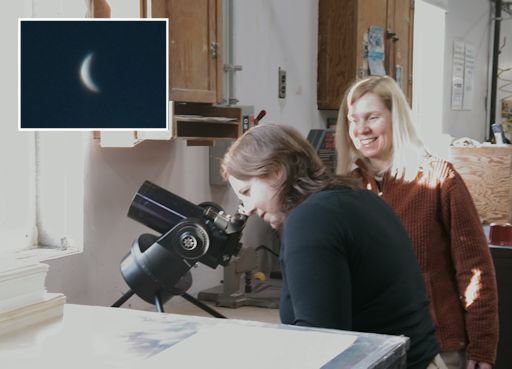
"Even with window glass and slight haze, the sight of Venus was beyond my greatest expectations. Others with small telescopes might find these inside star parties just as good as those outside this time of year, and introduce Venus, and perhaps the Sun and Moon to co-workers, while staying warm in the process!"
How do you find Venus through the window in broad daylight? Garrett offers this advice:
"Venus is easy to see right before I start work in strong twilight. The real trick is to do polar alignment indoors so the telescope can track Venus. Its easy with the ETX if you know where the North Pole is. I start tracking on Venus for a few minutes, and then see how it has moved away from the center of the eyepiece view. I then move the whole telescope to place Venus back in the center and it tracks perfectly after that."
Realtime Space Weather Photo Gallery