A BREAKTHROUGH FROM KEPLER: Today, NASA announced a breakthrough addition to the catalog of new planets. Researchers using Kepler have confirmed 715 new worlds, almost quadrupling the number of planets previously confirmed by the planet-hunting spacecraft. Some of the planets are similar in size to Earth and orbit in the habitable zone of their parent stars. [video]
MORNING CONJUNCTION AND ECLIPSE: This morning, Venus and the crescent Moon converged for a beautiful sunrise conjunction. In some places, the conjunction was so tight that the Moon actually eclipsed Venus. Ravindra Aradhya sends this picture from Bangalore, India, taken moments before Venus disappeared behind the lunar limb:

Like the Moon, Venus has phases, and today it was a 35% crescent. That's why the second planet looked like a "mini-Moon" through Aradhya's telescope. "A crescent Moon occulting a crescent Venus in morning daylight was an amazing sight," he says.
Hundreds of photographers recorded the event. Browse the gallery for more views:
Realtime Conjunction Photo Gallery
X-FLARE! Long-lived sunspot AR1967 returned to the Earthside of the sun on Feb. 25th and promptly erupted, producing an X4.9-class solar flare. This is the strongest flare of the year so far and one of the strongest of the current solar cycle. A movie from NASA's Solar Dynamics Observatory shows the explosion hurling a loop of hot plasma away from the blast site:
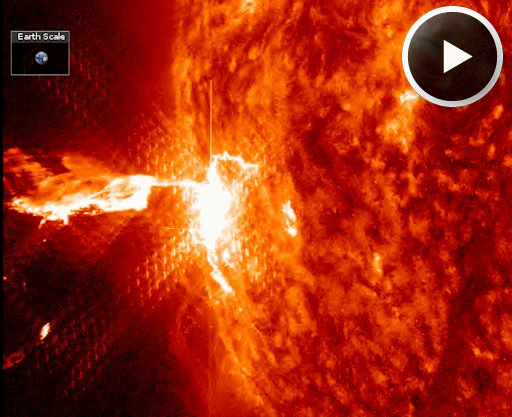
Coronagraphs onboard the Solar and Heliospheric Observatory tracked this material as it raced away from the sun, eventually forming a bright CME, pictured below.. Radio emissions from shock waves at the leading edge of the CME suggest an expansion velocity near 2000 km/s or 4.4 million mph. If such a fast-moving cloud did strike Earth, the resulting geomagnetic storms could be severe. However, because its trajectory is so far off the sun-Earth line, the CME will deliver a no more than a glancing blow. NOAA forecasters expect a weak impact late in the day on Feb. 26th.

The source of the eruption is long-lived sunspot AR1967, now beginning its third trip across the Earthside of the sun. This region was an active producer of flares during its previous transits, and it looks like the third time will be no different. By tradition, sunspots are renumbered each time they return, so AR1967 has been given a new name, AR1990. After today, that is what we will call it. Solar flare alerts: text, voice
Realtime Space Weather Photo Gallery