HELIOPHYSICS SUMMER SCHOOL: Are you an undergraduate physics or astronomy instructor? There might be a seat waiting for you at the 2014 Heliophysics Summer School. The program's sponsor, UCAR, is looking for a number of qualified instructors to attend with most expenses paid. Apply here. The deadline has been extended to March 22nd.
AURORA ROCKET LAUNCHED: Last night, with green lights swirling overhead, scientists at the University of Alaska's Poker Flat Research Range launched a 48-foot sounding rocket directly into the aurora borealis. "For weeks we've been sitting out all night every night, and though we've seen many good aurora, we haven't seen the type we wanted, in the position we wanted - until now," says graduate student Jason Ahrns, who sends this picture of the rocket in flight:
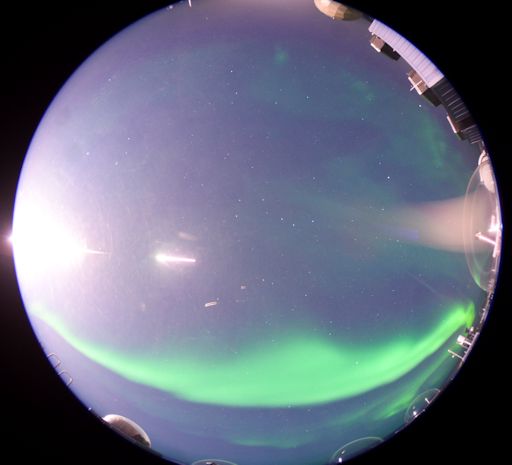
The rocket launch was part of a NASA-sponsored campaign called GREECE---short for "Ground-to-Rocket Electrodynamics-Electrons Correlative Experiment." Marilia Samara, a space scientist at the Southwest Research Institute in San Antonio, Texas, is the principal investigator.
GREECE aims to solve a long-standing mystery about auroras: Often, when a display begins, the lights are placid and widely spread across thousands of kilometers. Then, for reasons no one fully understands, the auroras will break up into highly-structured and rapidly changing arcs, swirls, curls, pillars, even "flames," with changes occurring on fraction-of-a-second time scales. Sensors on the Data from the sounding rocket will help researchers unravel the electrodynamics underlying these sudden and unpredictable transitions.
"Preliminary expectations are that the launch was a total and complete success with lots of good science to come out of it," reports Ahrns. Check the GREECE blog for updates. Aurora alerts: text, voice
BLUE AURORAS: Northern Lights are usually green, and sometimes red. Those are the colors produced by oxygen when it is excited by electrons raining down from space. On Feb. 22nd, Micha Bäuml of Straumfjord, Norway, witnessed an appariton of aurora-blue:

"All of a sudden the sky exploded," says Micha. "The aurora looked like a giant flame."
In auroras, blue is a sign of nitrogen. Energetic particles striking ionized molecular nitrogen (N2+) at very high altitudes produces a cold azure glow of the type captured in Micha's photo. Why it overwhelmed the usual hues of oxygen on Feb 22nd is unknown. Auroras still have the capacity to surprise.
Any auroras tonight, blue or otherwise, will be a bit of a surprise. Geomagnetic conditions are quiet. NOAA forecasters estimate a scant 5% chance of polar geomagnetic storms on March 3rd. Aurora alerts: text, voice
Realtime Space Weather Photo Gallery