HELIOPHYSICS SUMMER SCHOOL: Are you an undergraduate physics or astronomy instructor? There might be a seat waiting for you at the 2014 Heliophysics Summer School. The program's sponsor, UCAR, is looking for a number of qualified instructors to attend with most expenses paid. Apply here. The deadline has been extended to March 22nd.
OLD SUNSPOT: The lifespan of a typical sunspot is two to three weeks. This one is about to turn three months:
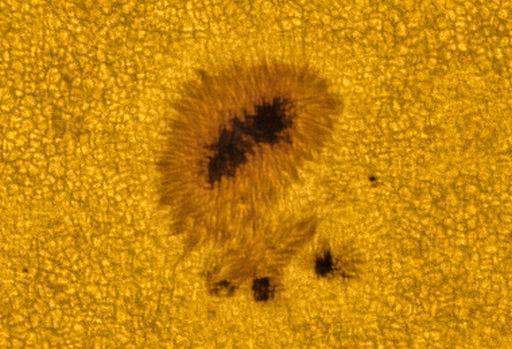
Carried around by the sun's 27-day rotation, AR1990 is making its third transit of the visible solar disk. In previous apparitions it was known as AR1944 and AR1967. Each time it has appeared, the sunspot has unleashed at least one strong flare, the most recent being the X4.9-class blockbuster of Feb. 25th. Since then, AR1990 has quieted and started showing signs of decay. Is this sunspot finally succumbing to time? Stay tuned.
Karzaman Ahmad of the Langkawi National Observatory in Malaysia took the above picture on March 3rd. He used an 11-inch telescope. The dimensions of the sunspot make it an easy target for such relatively small optics. Its dark core is about the size of Earth, and it is surrounded by boiling granules as large as the state of Texas. If you have a solar telescope, take a look. Solar flare alerts: text, voice
AURORA ROCKET LAUNCHED: On the night of March 3rd, with green lights swirling overhead, scientists at the University of Alaska's Poker Flat Research Range launched a 48-foot sounding rocket directly into the aurora borealis. "For weeks we've been sitting out all night every night, and though we've seen many good aurora, we haven't seen the type we wanted, in the position we wanted - until now," says graduate student Jason Ahrns, who sends this picture of the rocket in flight:
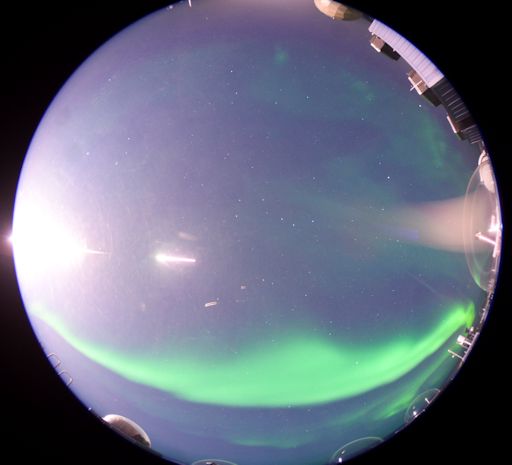
The rocket launch was part of a NASA-sponsored campaign called GREECE---short for "Ground-to-Rocket Electrodynamics-Electrons Correlative Experiment." Marilia Samara, a space scientist at the Southwest Research Institute in San Antonio, Texas, is the principal investigator.
GREECE aims to solve a long-standing mystery about auroras: Often, when a display begins, the lights are placid and widely spread across thousands of kilometers. Then, for reasons no one fully understands, the auroras will break up into highly-structured and rapidly changing arcs, swirls, curls, pillars, even "flames," with changes occurring on fraction-of-a-second time scales. Sensors on the Data from the sounding rocket will help researchers unravel the electrodynamics underlying these sudden and unpredictable transitions.
"Preliminary expectations are that the launch was a total and complete success with lots of good science to come out of it," reports Ahrns. Check the GREECE blog for updates. Aurora alerts: text, voice
HELIOPHYSICS SUMMER SCHOOL: Are you an undergraduate physics or astronomy instructor? There might be a seat waiting for you at the 2014 Heliophysics Summer School. The program's sponsor, UCAR, is looking for a number of qualified instructors to attend with most expenses paid. Apply here. The deadline has been extended to March 22nd.
Realtime Space Weather Photo Gallery