ASTEROID FLYBY: Today, asteroid 2014 DX110 will fly past Earth just inside the orbit of the Moon. There is no danger of a collision with the 30-meter space rock. At closest approach it will be approximately 350,000 km from our planet. [3D orbit] [photos: #1, #2]
FARSIDE CME: Hours ago, a bright coronal mass ejection (CME) flew over the sun's southeastern limb. If such an event had occured years ago, we wouldn't know if this CME was a threat because, as viewed from Earth orbit, CMEs heading toward and away from Earth look much the same. Today, however, all CMEs are observed from multiple points of view:
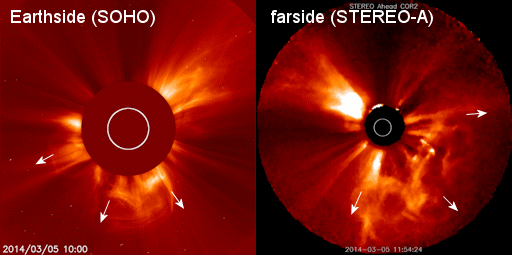
Dual coronagraph images from SOHO (stationed on the Earthside of the sun) and the STEREO-A probe (stationed on the farside) clearly show that this CME is a farside event. Radio emissions from shock waves at the leading edge of the blast suggest the cloud is racing away from Earth at approximately 1400 km/s (3 million mph). If it were racing in the opposite direction, we would have a significant geomagnetic storm in the offing. Instead, space weather around Earth is expected to remain calm for the rest of this week. Solar flare alerts: text, voice
Realtime Space Weather Photo Gallery
OLD SUNSPOT: The lifespan of a typical sunspot is two to three weeks. This one is about to turn three months:
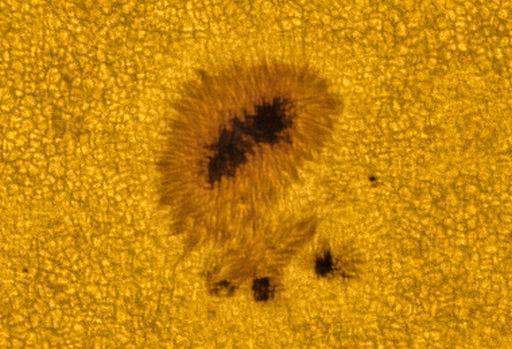
Carried around by the sun's 27-day rotation, AR1990 is making its third transit of the visible solar disk. In previous apparitions it was known as AR1944 and AR1967. Each time it has appeared, the sunspot has unleashed at least one strong flare, the most recent being the X4.9-class blockbuster of Feb. 25th. Since then, AR1990 has quieted and started showing signs of decay. Is this sunspot finally succumbing to time? Stay tuned.
Karzaman Ahmad of the Langkawi National Observatory in Malaysia took the above picture on March 3rd. He used an 11-inch telescope. The dimensions of the sunspot make it an easy target for such relatively small optics. Its dark core is about the size of Earth, and it is surrounded by boiling granules as large as the state of Texas. If you have a solar telescope, take a look. Solar flare alerts: text, voice
Realtime Space Weather Photo Gallery
HELIOPHYSICS SUMMER SCHOOL: Are you an undergraduate physics or astronomy instructor? There might be a seat waiting for you at the 2014 Heliophysics Summer School. The program's sponsor, UCAR, is looking for a number of qualified instructors to attend with most expenses paid. Apply here. The deadline has been extended to March 22nd.