FRIDAY IS PI DAY: Mark your calendar. This Friday, March 14th (3.14), is  day. It's an occasion to celebrate one of the most compelling and mysterious constants of Nature. Pi appears in equations describing the orbits of planets, the colors of auroras, the structure of DNA. The value of is woven into the fabric of life, the universe and ... everything.

Humans have struggled to calculate for thousands of years. Divide the circumference of a circle by its diameter; the ratio is . Sounds simple, but the devil is in the digits. While the value of is finite (a smidgen more than 3), the decimal number is infinitely long:
3.1415926535897932384626433832795
02884197169399375105820974944592307
81640628620899862803482534211706...more
Supercomputers have succeeded in calculating more than 2700 billion digits and they're still crunching. The weirdest way to compute : throw needles at a table or frozen hot dogs on the floor. Party time!
GROWING CHANCE OF FLARES: Sunspot AR2002 poses a growing threat for solar flares. Since the week began, the active region has more than tripled in size. It now has more than a dozen dark cores and sprawls across 100,000 km of solar terrain. Karzaman Ahmad sends this picture, taken just hours ago, from the Langkawi National Observatory in Malaysia:
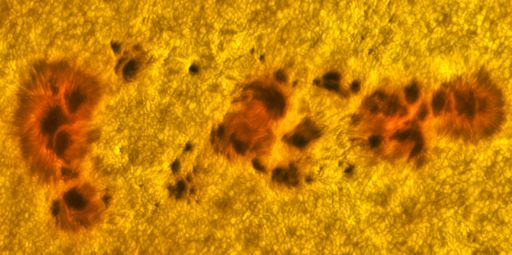
"AR2002 is so large," says Ahmad, "that I was able to photograph it using an ordinary 11-inch Celestron telescope capped with a Thousand Oaks Glass Filter." The exceptionally crisp image shows thousands of boiling granules surrounding the sunspot's dark cores. Each granule is about the size of Texas.
A 48-hour movie from NASA's Solar Dynamics Observatory shows the sunspot's development:

The rapid growth of AR2002 has destabilized its magnetic field, which makes it more likely to erupt. NOAA forecasters estimate a 60% chance of M-class flares and a 10% chance of X-class flares during the next 24 hours. Solar flare alerts: text, voice
Realtime Space Weather Photo Gallery
STORM CLOUDS ON MARS: Next month, Earth and Mars will converge for their closest approach of 2014. Opposition occurs on April 8th. That's when Mars rises in the east at sunset, almost perfectly opposite the sun, and soars overhead at midnight shining 8 times brighter than a 1st-magnitude star. Although closest approach is still weeks away away, astronomers are already enjoying great views of the Red Planet. Australian astrophotographer Anthony Wesley took this picture using a 16-inch telescope on March 6th:

His high-resolution image shows orographic clouds over the Elysium volcanoes just north of the Martian equator and an even brighter blue cloud over the Hellas impact basin in the southern hemisphere. Hellas is the lowest point on Mars, and some of the haze evident there could be icy fog.
Getting such Hubblesque results from a 16-inch telescope requires a combination of good seeing and long years of experience. Wesley, who is one of the world's top amateur astrophotographers, had both working for him on the morning of March 6th. "Skies were stable and clear," he says. "Using a Point Grey Research low-light Grasshopper3 camera, I recorded 2 minutes through red, green and blue filters with red @ 83fps, green @ 70fps and blue @ 50fps. I sorted all the frames according to image sharpness and stacked the best 2000 in each channel to make the color image, with additional wavelet sharpening in Registax, deconvolution in Astra Image and final color correction and touchups+captioning in the GIMP."
Observers with less experience can take good photos, too, especially as March gives way to April and Mars approaches Earth. Look for burnt-orange Mars rising in the east around around 10 p.m. about 5° from the blue 1st-magnitude star Spica. The Moon passes by Mars on March 19-20 and provides a convenient "landmark" for finding the Red Planet. For more information about what you can expect to see on Mars, click here.
HELIOPHYSICS SUMMER SCHOOL: Are you an undergraduate physics or astronomy instructor? There might be a seat waiting for you at the 2014 Heliophysics Summer School. The program's sponsor, UCAR, is looking for a number of qualified instructors to attend with most expenses paid. Apply here. The deadline has been extended to March 22nd.