GREEN SKIES ON ST. PATRICK'S DAY? NOAA forecasters estimate a 15% chance of polar geomagnetic storms on March 17th. That means the odds of green skies on St. Patrick's Day are low. Instead, look for shamrock colors here. Solar flare alerts: text, voice
SPACE WEATHER BALLOON--DOUBLE LAUNCH: Yesterday, the students of Earth to Sky Calculus launched a pair of research balloons into the stratosphere. One of the balloons carried an experimental Space Weather payload designed for rapid deployment during unexpected solar storms. Here it is, photographed in flight by the companion balloon:
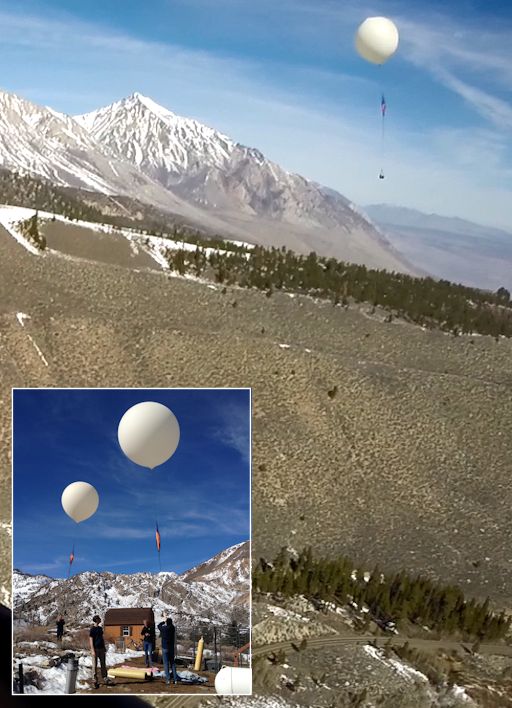
The two balloons were about 18,000 feet above sea level when the photo was taken. One balloon photographing another in flight is a rare and possibly unique occurrence in the growing field of high-altitude ballooning. Congratulations to the students for breaking new ground in the air.
There was no solar storm yesterday. The test flight of the Rapid Response Space Weather Payload prepares the team for another day when a strong flare or geomagnetic storm takes forecasters by surprise. This fast-turnaround payload can be dispatched on a moment's notice to probe the stratosphere while the storm is underway. It includes a high-energy radiation sensor, a cryogenic thermometer, a GPS altimeter and other devices. Stay tuned for more data and images from the flight.
UPDATED--ERUPTING FILAMENT CREATES A 'CANYON OF FIRE': For days, amateur astronomers have been monitoring two long, dark filaments of magnetism snaking around the sun's southeastern limb. On March 16th, one of them became unstable and erupted. The resulting explosion split the sun's atmosphere, creating a "canyon of fire," shown here in a movie captured by the Solar Dynamics Observatory:

The glowing walls of the canyon are formed in a process closely related to that of arcade loops, which appear after many solar flares. The structure traces the original channel where the filament was suspended by magnetic forces above the stellar surface.
As erupting magnetic filaments often do, this one launched a coronal mass ejection (CME) into space. Update: The Solar and Heliospheric Observatory recorded a movie of the cloud expanding at 800 km/s (1.8 million mph). NOAA analysts say the CME is traveling south of the sun-Earth line and should not be geoeffective. Solar flare alerts: text, voice

Realtime Space Weather Photo Gallery