QUIET SUN: Despite a relatively high sunspot number, solar activity is low. None of the half-dozen sunspot groups on the solar disk is actively flaring. NOAA forecasters estimate a 35% chance of M-class flares and a 5% chance of X-flares on March 18th. Solar flare alerts: text, voice
APPROACHING MARS: Count slowly: one one-thousand, two one-thousand, three one-thousand.... You're now 30 km closer to the planet Mars. Earth and Mars are converging for a close encounter in April 2014, an event astronomers call "opposition." At closest approach on April 14th, burnt-orange Mars will rise in the east at sunset and soar almost overhead at midnight shining 8 times brighter than a 1st magnitude star. Even now the view is impressive:

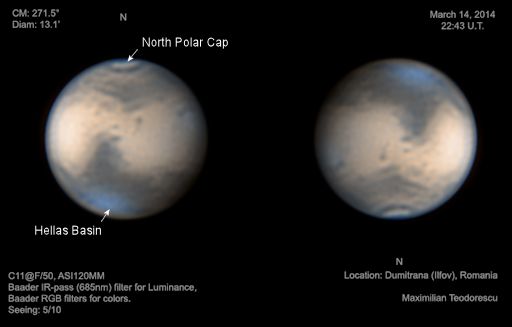
Romanian astrophotographer Maximilian Teodorescu took the picture on March 14th using an 11-inch Celestron telescope. "The Red Planet has a lot to offer," he says. "With the opposition getting closer every day, details are becoming more easily discernible." Teodorescu's images show a bank of icy clouds covering Hellas Basin, the widest and deepest impact crater on Mars. Also visible is the North Polar Cap, which is rapidly evaporating as summer unfolds in Mars' northern hemisphere.
Ready to see Mars for yourself? Tonight, March 18-19, the waning full Moon will pass by Mars in the constellation Virgo, making the Red Planet easy to locate. Point your optics at the bright burnt-orange "star" a few degrees above the lunar disk. Update: You're now about 600 km closer to Mars.
SPACE WEATHER BALLOON--DOUBLE LAUNCH: On March 16th, the students of Earth to Sky Calculus launched a pair of research balloons into the stratosphere. One of the balloons carried an experimental Space Weather payload designed for rapid deployment during unexpected solar storms. Here it is, photographed in flight by the companion balloon:
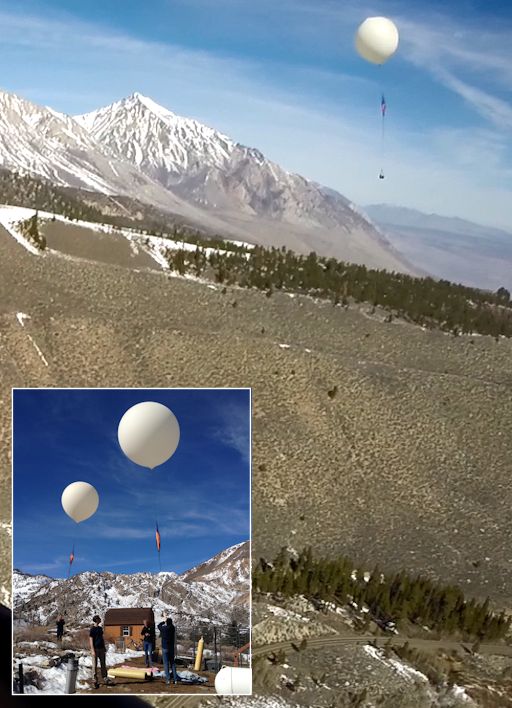
The two balloons were about 10,000 feet above sea level when the photo was taken. One balloon photographing another in flight is a rare and possibly unique occurrence in the growing field of high-altitude ballooning. Congratulations to the students for breaking new ground in the air.
There was no solar storm yesterday. The test flight of the Rapid Response Space Weather Payload prepares the team for another day when a strong flare or geomagnetic storm takes forecasters by surprise. This fast-turnaround payload can be dispatched on a moment's notice to probe the stratosphere while the storm is underway. It includes a high-energy radiation sensor, a cryogenic thermometer, a GPS altimeter and other devices. Stay tuned for more data and images from the flight.
Realtime Space Weather Photo Gallery