CHINESE MOON ROVER UPDATE: China's lunar rover, the "Jade Rabbit", is awake and communicating with Earth. The rover had recently hunkered down to survive its third night on the Moon. Mission controllers weren't sure the Jade Rabbit could survive as darkness fell for two weeks and temperatures plunged as low as -170 C. But survive it did, although the rover can no longer move. Stuck in place, Jade Rabbit continues to gather data about its surroundings in Sinus Iridum (the Bay of Rainbows). The mission was designed to last only 3 months, so every byte that comes back now is a bonus. [more]
DOUBLE FLARE: Long ago researchers thought solar flares were isolated events. Magnetic fields above a single sunspot became unstable and exploded--end of story. The Solar Dynamics Observatory's global view of the sun has shown, however, that widely-separated sunspots can explode in tandem. That's what happened on March 20th when AR2010 and AR2014 combined for a double flare:
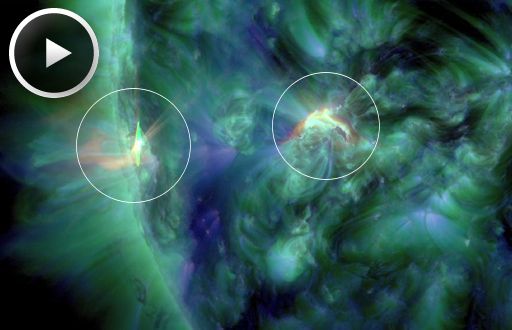
Transparent arcs of magnetism stretching across the 400,000 km divide between the two sunspots allow them to communicate magnetohydrodynamically, so instabilities in one can affect the other. This appears to be a textbook example of a 'sympathetic flare.' The most famous example occurred on August 1, 2010. SDO watched as instabilities jumped vast distances from one sunspot to another, setting off a chain reaction that engulfed more than half the sun. Compared to that global eruption, today's double flare was puny--or as puny as two explosions more powerful than a billion nuclear bombs can be. Welcome to the sun. Solar flare alerts: text, voice
Realtime Space Weather Photo Gallery
SOLAR 'SUPERSTORM' NARROWLY MISSES EARTH: The heliophysics communitty is buzzing today in response to an article in Nature Communications, which describes an intense solar storm that narrowly missed Earth almost two years ago. On July 23, 2012, a CME rocketed away from the sun at 2000 km/s, almost four times faster than a typical eruption. The storm tore through Earth orbit, but fortunately Earth wasn't there. Instead it hit the STEREO-A spacecraft, which experienced the most intense solar proton storm since 1976. Researchers have been analyzing the data ever since, and they have concluded that the storm was akin to the Carrington Event of 1859. Scroll past this movie of the CME to learn more:
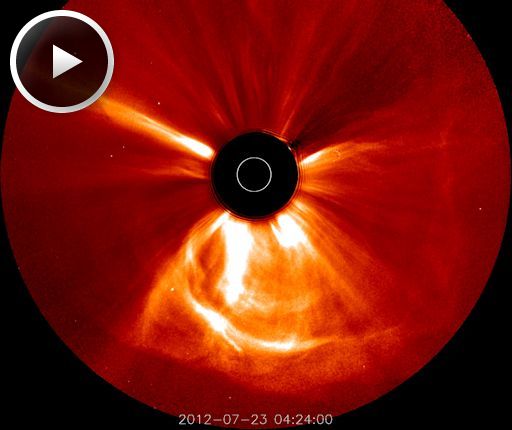
"Had it hit Earth, it probably would have been like the big one in 1859," says Janet Luhmann of UC Berkeley, a co-author of the paper. "The effect today [on] our modern technologies would have been tremendous."
The Carrington Event was a series of powerful CMEs that hit Earth head-on, sparking Northern Lights as far south as Tahiti. Intense geomagnetic storms caused global telegraph lines to spark, setting fire to some telegraph offices and disabling the 'Victorian Internet." A similar storm today would have a catastrophic effect on modern power grids and telecommunication networks. According to a study by the National Academy of Sciences, the total economic impact could exceed $2 trillion or 20 times greater than the costs of a Hurricane Katrina. Multi-ton transformers fried by such a storm could take years to repair.
The paper in Nature Communications describes what gave the July 2012 storm Carrington-like potency. For one thing, the CME was actually two CMEs separated by only 10 to 15 minutes. Plus the CMEs traveled through a region of space that had been cleared out by another CME four days earlier. As a result, they were not decelerated as much as usual by their transit through the interplanetary medium.
The storm clouds crossed Earth's orbit in a place where Earth itself would be about 1 week later, so it was a relatively narrow escape. The whole episode highlights the perils of space weather. Many observers have noted that the current solar cycle is weak, perhaps the weakest in 100 years. Now we see that even a weak solar cycle can produce a very strong storm. Earth is not safe from these kind of events, so it's time to be prepared.
The original research reported here may be found in Nature Communications: "Observations of an extreme storm in interplanetary space caused by successive coronal mass ejections" by Ying D. Liu et al., published on March, 18, 2014.