GLANCING-BLOW CME, INCOMING: A CME launched from sunspot AR2014 on March 23rd is expected to deliver a glancing blow to Earth's magnetic field on March 25th. NOAA forecasters estimate a 30%-40% chance of polar geomagnetic storms on March 25-26. Aurora alerts: text, voice
LONG-DURATION FLARE: On March 23rd around 0330 UT, the magnetic canopy of sunspot AR2014 became unstable and erupted, producing a long-duration C-class solar flare. Although C-class flares are considered to be minor, this one lasted so long (several hours) that it unleashed the energy-equivalent of a much stronger flare. NASA's Solar Dynamics Observatory recorded the action:
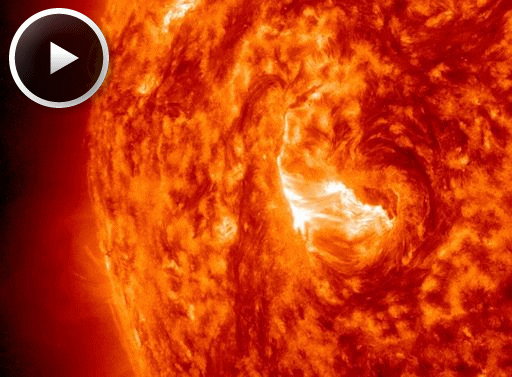
Slow flares usually produce CMEs and this one was no exception. The Solar and Heliospheric Observatory (SOHO) recorded a bright cloud emerging from the blast site: movie. The CME was not aimed at Earth. Nevertheless, it will have an effect on our planet. NOAA analysts say the CME will deliver a glancing blow to Earth's magnetic field on March 25th. Solar flare alerts: text, voice

Realtime Space Weather Photo Gallery
RED MARS, BLUE SPICA, BIG ASTEROIDS: Mars is approaching Earth for a close encounter in mid-April. As the two planets converge, the red color of Mars is becoming increasingly vivid to the naked eye. This is especially true because Mars is located not far from Spica, a blue-giant star of first magnitude in the constellation Virgo. Each evening when Mars and Spica rise side by side in the eastern sky, the red-blue contrast is eye-catching:
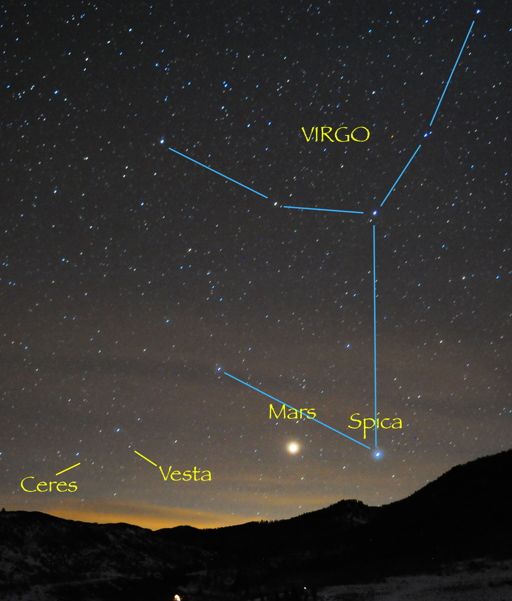
Astronomy professor Jimmy Westlake of Colorado Mountain College took the picture on March 20th, the first night of northern spring, and labeled it to show not only "ruddy Mars and icy-blue Spica," but also two nearby space rocks.
"This spring, Mars is looping through the stars of Virgo alongside the large asteroids Ceres and Vesta," explains Westlake. "All three reach opposition next month: Mars on April 8th, Vesta on April 13th, and Ceres on April 15th. Vesta, the nearer and more reflective of the two, appears about a magnitude brighter than Ceres. Both are within easy grasp of binoculars."
Look for Mars and Spica rising in the east after sunset, around 9 pm local time. A backyard telescope pointed at Mars will show you more than a red dot. Mars's north polar cap, surface features and clouds are being photographed by amateur astronomers around the world as the red planet grows larger in the eyepiece every night. Browse the gallery for examples: