A 'TETRAD' OF LUNAR ECLIPSES: A total lunar eclipse on April 15th marks the beginning of a 'tetrad' -- a series of four consecutive lunar eclipses all visible from North America. Get the full story from Science@NASA.
HUBBLE SEES JETS IN MARS COMET: Later this year, Mars is going to have a close encounter with a comet. On Oct. 19, 2014, Comet Siding Spring (C/2013 A1) will buzz the Red Planet about 10 times closer than any known comet has ever flown past Earth. Mars could actually find itself inside the comet's extended atmosphere as the comet passes by only 138,000 km away. Needless to say, NASA is watching carefully. The latest images from the Hubble Space Telescope show jets spewing from the comet's core:
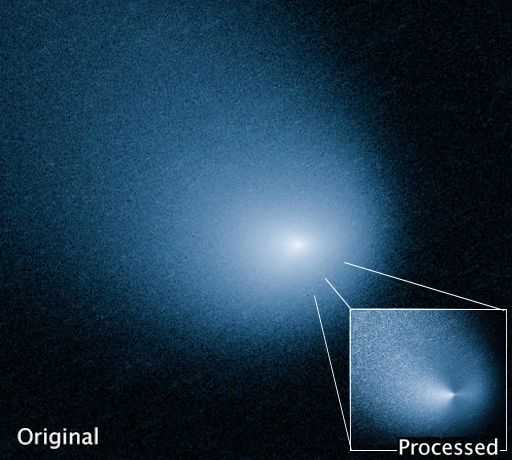
The image, captured on March 11th, shows comet Siding Spring at a distance of 353 million miles from Earth. Hubble can't see the icy nucleus because it is hidden inside the comet's glowing dusty atmosphere. Nevertheless, image processing did reveal what appears to be two jets of dust coming off the nucleus in opposite directions. This observation allows astronomers to calculate the direction of the nucleus's pole, and axis of rotation.
"This is critical information that we need to determine whether, and to what degree, dust grains in the [atmosphere] of the comet will impact Mars and spacecraft orbiting Mars," says Jian-Yang Li of the Planetary Science Institute in Tucson, Arizona.
Indeed, meteoroids from the comet could hit NASA's Mars orbiters and damage them even as the orbiters try to study the comet. The level of risk won't be known for months, but NASA is already evaluating possible precautionary measures. Data from Hubble and other observatories in the months ahead will clarify the dangers. Stay tuned for full coverage. Solar flare alerts: text, voice
Realtime Space Weather Photo Gallery
AN ASTEROID WITH RINGS: On March 26th, astronomers at a press conference in Brazil announced the surprising discovery of an asteroid with rings. The 250-km-wide asteroid, named Chariklo, is located in the outer solar system between Saturn and Uranus. In June 2013, observers used seven different telescopes in South America to watch the asteroid pass in front of a distant star. The star winked out not just once, as would be expected for a solitary asteroid, but multiple times, revealing a pair of dense narrow rings surrounding the space rock. Here is an artist's concept of the system:

"We weren't looking for a ring and didn't think small bodies like Chariklo had them at all, so the discovery — and the amazing amount of detail we saw in the system — came as a complete surprise!" says Felipe Braga-Ribas of Observatório Nacional/MCTI in Rio de Janeiro. He planned the observing campaign and is the lead author of a March 26th paper in Nature describing the results.
According to their analysis, the rings are only 3 km and 7 km wide, respectively, with a 9 km gap between them. "I try to imagine how it would be to stand on the surface of this icy asteroid and stare up at a such a ring system 1000 times closer than the Moon," adds team member Uffe Gråe Jørgensen of the Niels Bohr Institute in Denmark.
Because the rings are so narrow, they are probably confined and shepherded by small satellites. "So, as well as the rings, it's likely that Chariklo has at least one small moon still waiting to be discovered," adds Felipe Braga Ribas. For more information about this discovery, click here.