POTENT SUNSPOT: Sunspot AR2017 in the sun's northern hemisphere is crackling with M-class solar flares, and it has a delta-class magnetic field that harbors energy for even stronger eruptions. Earth-directed flares are possible this weekend. Solar flare alerts: text, voice
update: AR2017 has just unleashed an X1-class solar flare. NASA's Solar Dynamics Observatory captured the extreme ultraviolet flash on March 29th at 1752 UT:

It is too soon to say whether this potent explosion hurled a CME toward Earth. Stay tuned for updates in the hours ahead.
Realtime Space Weather Photo Gallery
OPPOSITION OF MARS: Earth and Mars are converging for a close encounter in April. It's only March, but the view through backyard telescopes is already superb. Michael A. Phillips of Swift Creek, NC, took this picture using a 14-inch telescope on March 27:
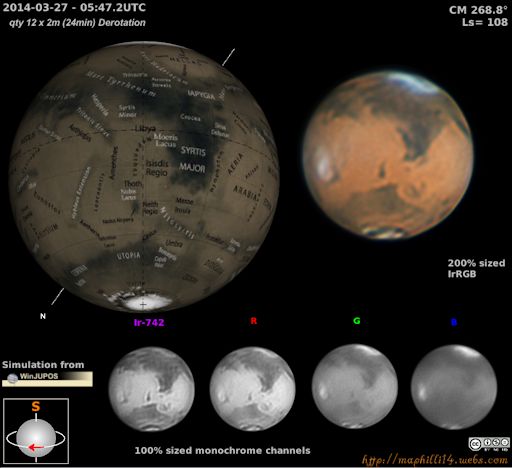
In Phillips's picture, south is up. It shows the rapidly evaporating North Polar Cap (summer arrived in February), orographic clouds over martian volcanoes near the equator, and a bright blue cloud filling Hellas Basin in the south. Only an experienced astrophotographer can produce this kind of Hubblesque detail using backyard optics. Novice observers looking through the eyepiece of a small telescope can still see a lot, however, including the rusty-red disk of Mars and bright smudges corresponding to the polar cap and Hellas Basin.
The view will improve in April. Get ready to see the Red Planet at its best as explained in "The Opposition of Mars" from Science@NASA.
HUBBLE SEES JETS IN MARS COMET: Later this year, Mars is going to have a close encounter with a comet. On Oct. 19, 2014, Comet Siding Spring (C/2013 A1) will buzz the Red Planet about 10 times closer than any known comet has ever flown past Earth. Mars could actually find itself inside the comet's extended atmosphere as the comet passes by only 138,000 km away. Needless to say, NASA is watching carefully. The latest images from the Hubble Space Telescope show jets spewing from the comet's core:
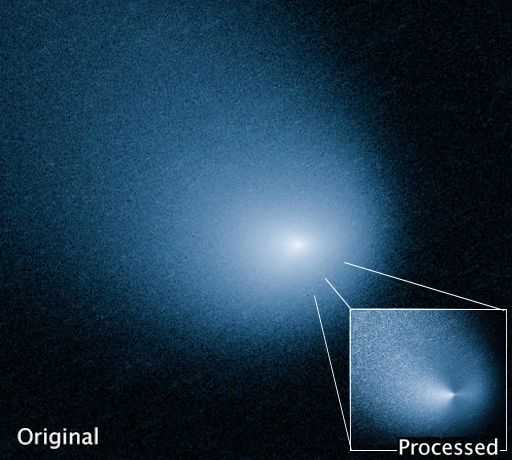
The image, captured on March 11th, shows comet Siding Spring at a distance of 353 million miles from Earth. Hubble can't see the icy nucleus because it is hidden inside the comet's glowing dusty atmosphere. Nevertheless, image processing did reveal what appears to be two jets of dust coming off the nucleus in opposite directions. This observation allows astronomers to calculate the direction of the nucleus's pole, and axis of rotation.
"This is critical information that we need to determine whether, and to what degree, dust grains in the [atmosphere] of the comet will impact Mars and spacecraft orbiting Mars," says Jian-Yang Li of the Planetary Science Institute in Tucson, Arizona.
Indeed, meteoroids from the comet could hit NASA's Mars orbiters and damage them even as the orbiters try to study the comet. The level of risk won't be known for months, but NASA is already evaluating possible precautionary measures. Data from Hubble and other observatories in the months ahead will clarify the dangers. Stay tuned for full coverage.