CMEs MISS EARTH: NOAA forecasters have downgraded the chance of geomagnetic storms on April 3rd to only 1%. This follows a storm warning on April 2nd when a group of CMEs were expected to sideswipe Earth's magnetic field. However, all of the CMEs appear to have missed our planet. Aurora alerts: text, voice
M6-CLASS SOLAR FLARE: Northern sunspot AR2027 erupted on April 2nd at 14:05 UT, producing a significant M6-class solar flare. NASA's Solar Dynamics Observatory recorded the extreme ultraviolet blast:

In the movie, you can see material being hurled into space. That is the genesis of a spectacular CME now racing away from the sun's eastern limb. Our planet was not in the line of fire, but the expanding cloud might nevertheless have an Earth-directed component. Stay tuned for updates. Aurora alerts: text, voice

Realtime Space Weather Photo Gallery
DAYLIGHT REQUIRED: In the night sky, there are thousands of stars visible to the unaided eye, and thousands of times more stars in range of backyard optics. Not a single one of those faraway balls of fire, however, looks any bigger than a pinprick. For a better view of a star, you need some daylight:
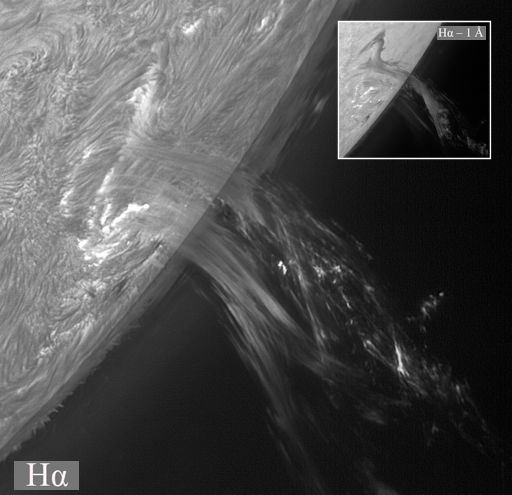
This star is the sun. Francois Rouviere of Mougins, France, took the picture on March 31st using no more than a 7-inch refracting telescope and an "H-alpha" filter tuned to the red glow of solar hydrogen.
"I caught this impressive explosion at the sun's western limb near sunspot AR2014," says Rouviere. "The inset, which is at a wavelength 1 Å shorter than H-alpha, shows fast moving material blue-shifted by the Doppler effect."
Got a solar telescope? NOAA forecasters estimate a 40% chance of M-class flares and a 5% chance of X-flares on April 3rd. Train those optics on the daylight sky. Solar flare alerts: text, voice
Note: Always use safe solar filters when observing the sun. Unfiltered sunlight, focused by optics, can cause serious eye damage.
Realtime Space Weather Photo Gallery
APPROACHING MARS: In the next 60 seconds you will be 300 km closer to the planet Mars. As April begins, Earth and Mars are converging at 5 km/s or 300 km/min for a close approach two weeks from now. This matrix of images, taken by Puerto Rican photographer Efrain Morales Rivera, shows how the Red Planet has grown in the eyepiece of his 12-inch telescope over the past month:

Even the smallest of Rivera's images shows the martian North Polar Cap, orographic clouds over volcanoes near the equator, and a bright blue cloud filling Hellas Basin in the south. Only an experienced astrophotographer can produce this kind of Hubblesque detail using backyard optics. Novice observers looking through the eyepiece of a small telescope can still see a lot, however, including the rusty-red disk of Mars and bright smudges corresponding to the polar cap and Hellas Basin.
Closest approach, Earth to Mars, occurs on April 14th at a distance of 92 million kilometers. Mark your calendar and get ready to see Mars at its best.