WEAK IMPACT: Solar wind signatures suggest that a CME delivered a glancing blow to Earth's magnetic field during the early hours of April 5th. The weak impact did not spark a geomagnetic storm. Nevertheless, high-latitude auroras are possible as Earth passes through the wake of the CME. Aurora alerts: text, voice
FARSIDE SOLAR ACTIVITY: Earlier today the Solar and Heliospheric Observatory (SOHO) photographed CMEs billowing away from almost the entire circumference of the visible solar disk. Click to set the clouds in motion:

None of the clouds is heading for Earth. They are farside CMEs. NASA's STEREO probes recorded multiple explosions on the solar farside just before the CMEs emerged. The active regions responsible for the CMEs will rotate around to the Earthside of the sun in 1 to 2 weeks, where they might pose a threat for Earth-directed explosions. Solar flare alerts: text, voice
Realtime Space Weather Photo Gallery
DAYLIGHT REQUIRED: In the night sky, there are thousands of stars visible to the unaided eye, and thousands of times more stars in range of backyard optics. Not a single one of those faraway balls of fire, however, looks any bigger than a pinprick. For a better view of a star, you need some daylight:
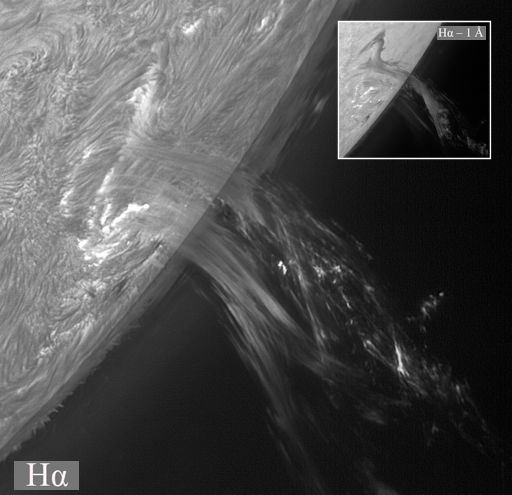
This star is the sun. Francois Rouviere of Mougins, France, took the picture on March 31st using no more than a 7-inch refracting telescope and an "H-alpha" filter tuned to the red glow of solar hydrogen.
"I caught this impressive explosion at the sun's western limb near sunspot AR2014," says Rouviere. "The inset, which is at a wavelength 1 Å shorter than H-alpha, shows fast moving material blue-shifted by the Doppler effect."
Got a solar telescope? NOAA forecasters estimate a 40% chance of M-class flares and a 5% chance of X-flares on April 4th. Train those optics on the daylight sky. Solar flare alerts: text, voice
Note: Always use safe solar filters when observing the sun. Unfiltered sunlight, focused by optics, can cause serious eye damage.