TOTAL LUNAR ECLIPSE: Mark your calendar. On April 15th, there will be a total eclipse of the Moon visible from Australia, New Zealand, and all of the Americas. The action begins on Tuesday at 2 AM Eastern time. Get the full story and a video from Science@NASA.
SUBSIDING STORM: A polar geomagnetic storm that began during the late hours of April 11th is subsiding now. At its peak, the storm registered 5 on the Kp scale of magnetic disturbances, which means it was a relatively minor event. Nevertheless, it was strong enough to spark naked-eye auroras. A family of "aurora addicts" traveling through Boden, Sweden, took this picture of the light:
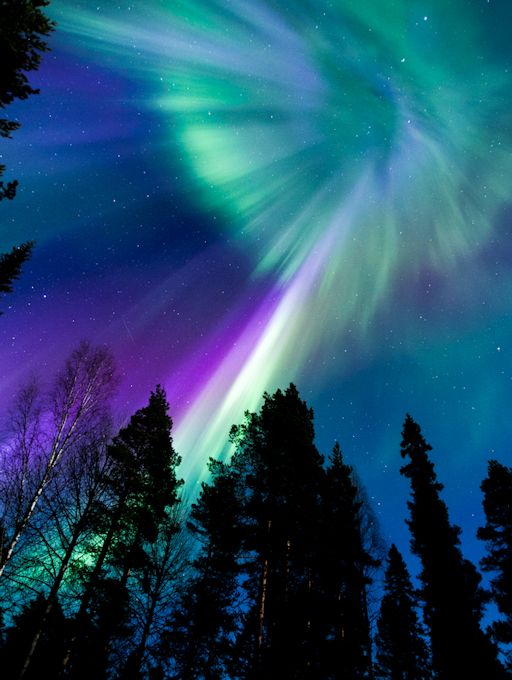
The storm began on April 11th when the interplanetary magnetic field (IMF) near Earth tipped south, opening a crack in our planet's magnetosphere. Solar wind poured in to fuel the display. Although the storm is subsiding, more auroras are possible on April 12th. NOAA forecasters estimate a 40% chance of renewed geomagnetic storming during the next 24 hours. Aurora alerts: text, voice
SPACE STATION TRANSITS THE MOON: Three nights ago, astrophotographers Pete Lawrence and Ian Sharp stood in Sharp's back garden in Ham UK waiting for a spaceship to pass in front of the Moon. When it happened, their eyes barely registered the event. High-speed cameras, however, recorded a beautiful view of the ISS speeding over the Sea of Tranquillity:

"Thanks to Pete Lawrence for alerting me to this," says Sharp, who took the picture using a 5-inch refractor. "Pete made the 5 mile trip to setup here and we both imaged the event separately and successfully." [Lawrence's photo]
The ISS transiting the Moon sounds like a rare event, but it happens more often than you might suppose. Only one night earlier, on April 8th, Maximilian Teodorescu of Daia (Giurgiu), Romania, photographed a similar flyby. Most transits go unnoticed because they are so brief. The ISS, moving faster than 17,000 mph, completes its trip across the lunar disk in only a fraction of a second. If you would like to catch the ISS in the act, check Calsky for predicted lunar transits over your home town.
Realtime Space Weather Photo Gallery