NASA SPACECRAFT HITS THE MOON: There's a new crater on the Moon. NASA's LADEE spacecraft, on a mission since Sept. 2013 to study the lunar atmosphere, has crashed. The impact was deliberate. LADEE was near the end of its planned mission and the grazing impact gave researchers a chance to study "lunar air" very close to the Moon's surface: full story.
M7-CLASS SOLAR FLARE (UPDATED): Sunspot AR2036 erupted on April 18th at 1307 UT, producing a strong M7-class solar flare. NASA's Solar Dynamics Observatory recorded the extreme ultraviolet flash:

An S1-class radiation storm is underway in the aftermath of the flare. However, this is a relatively minor storm which poses minimal threat to satellites and aircraft.
Of greater interest is a CME that emerged from the blast site. The Solar and Heliospheric Observatory recorded the storm cloud racing away from the sun at aproximately 800 km/s:

This CME could deliver a glancing blow to Earth's magnetic field on April 20-21. Two or three minor CMEs traveling ahead of this one are expected to arrive on April 19-20, and the combined impacts could generate geomagnetic activity throughout the weekend. NOAA forecasters put the odds of a geomagnetic storm at 55% on Saturday, increasing to 75% on Sunday. High-latitude sky watchers should be alert for auroras. Solar flare alerts: text, voice
Realtime Space Weather Photo Gallery
DRAGON SIGHTED: Chalking up another success for commercial spaceflight, SpaceX's Dragon cargo carrier is in orbit and en route to the International Space Station. The spacecraft launched atop a Falcon 9 rocket from Cape Canaveral on Friday, April 18th, at at 3:25 p.m. EDT. Shortly after the launch, observers across Europe watched the spacecraft sail through their darkening evening sky. Astrophotographer sends this movie from Paris, France:
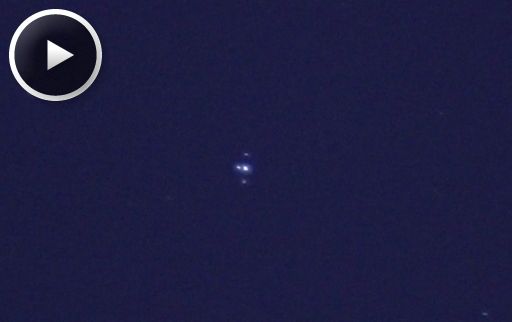
The brightest dot in the movie is the Dragon itself. As for the other three objects, "I don't know what they are!" says Legault. "They are probably debris such as solar panel covers or the rocket cap. I would be interested to know."
Dragon will reach the ISS on Sunday, April 20th, at 7:14 am EDT. Using the space station's robotic arm, ISS Commander Koichi Wakata will take hold of the spacecraft and maneuver it to its docking port, where astronauts will begin to unload 2.5 tons of supplies and science experiments.
On its way to the ISS, SpaceX's Falcon rocket jettisoned five CubeSats. One of the satellites, PhoneSat 2.5, is the third in a series of CubeSat missions designed to use commercially available smartphone technology as part of a low-cost development effort to provide basic spacecraft capabilities. Another of the small satellites, SporeSat, is designed to help scientists study how plant cells sense gravity -- valuable research in the larger effort to grow plants in space.
Dragon is scheduled to depart the space station May 18th for a splashdown in the Pacific Ocean, west of Baja California, bringing from the space station nearly 3,500 pounds of science, hardware, crew supplies and spacewalk tools. Dragon's ability to return materials from space sets it apart from other cargo carriers that burn up upon re-entry.
Realtime Eclipse Photo Gallery