LETTUCE ORBIT EARTH: A new life form is taking root on the ISS, and its name is "Outregeous." Astronauts would like to eat it, but mission controllers are not giving permission ... yet. Get the full story from Science@NASA.
RADIO BLACKOUT: An X-class solar flare on April 25th irradiated Earth's upper atmosphere with extreme ultraviolet radiation. Waves of ionization rippled around the dayside of the planet, causing a widespread blackout of shortwave radio transmissions. Radio astronomer Dick Flagg recorded the event at his observatory at the Windward Community College on Oahu:

"This is a dynamic spectrum," explains Flagg. "The vertical axis is frequency (MHz) and the horizontal axis is time (UTC)." All of the horizontal lines corresponding to terrestrial radio stations vanished in the aftermath of the flare.
The active region responsible for the flare rotated off the solar disk yesterday, so even if it flares again, another radio blackout is unlikely this weekend. NOAA forecasters estimate the odds of an X-flare on April 26th to be a scant 1%. Solar flare alerts: text, voice
Realtime Space Weather Photo Gallery
DOOMED MOON OF MARS: Mars has two small moons: Phobos and Deimos. One of them is doomed. Phobos orbits so close to Mars - about 5,800 kilometers above the surface compared to 400,000 kilometers for our own Moon - that gravitational tidal forces are dragging it down. In 100 million years or so Phobos will likely be shattered by tidal shear, the debris forming a decaying ring around Mars.
With the countdown clock clicking, astrophotographer Peter Rosén was determined to photograph the diminutive moon, and on April 24th he succeeded:
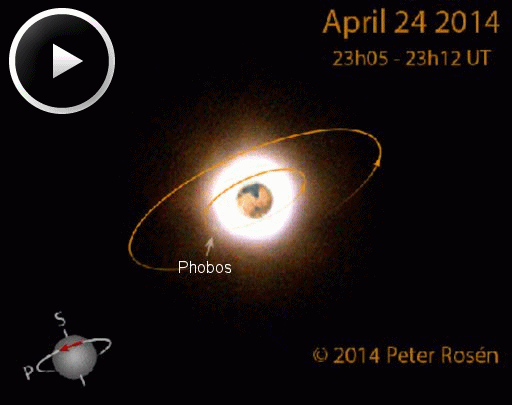
"My previous attempt at photographing Phobos and Deimos resulted in Deimos alone, so I tried again last night, slightly changing my setup," says Rosén. "This time I managed to get the even more elusive Phobos at mag. 11.8 , separated only by 11 arcseconds from the blindingly bright Mars at mag. -1.28."
"I inserted the orbital path of both moons to show how much closer Phobos is to the planet compared to Deimos and also that Phobos is on track."
"So why doesn't Deimos show in this 2-frame animation?," he asks. "It was positioned below the planet at a separation of 15 arcseconds at that time and being a full magnitude dimmer (almost 13) it was just invisible."