QUIET SUN: Solar activity is low. Only a few sunspots are facing Earth, and none has the kind of complex magnetic field that harbors energy for strong explosions. NOAA forecasters estimate a waning 10% chance of M-class flares and only a 1% chance of X-flares on April 27th. Solar flare alerts: text, voice
MYSTERIOUS SUN PILLAR ECHOS: Many of us have witnessed sun pillars--columns of light that lance upwards from the horizon just as the sun is rising or setting. They are caused by plate-shaped ice crystals in clouds that bend the rays of the low-hanging sun. While sun pillars are frequently seen, in all seasons and at all latitudes, elusive companions of sun pillars may have been frequently overlooked. They are called sun pillar "echos":


Image credit: Jon Inghram. Larger images: #1, #2

Atmospheric optics expert Les Cowley explains: "13 years ago in Finland, three halo experts saw peculiar 'echoes' straddling an otherwise ordinary sun pillar. They could not be explained and there the matter rested for want of confirmation by another observation. Then, last week, Jon Inghram sent me several sun pillar images. He too had noticed faint 'echoes' on each side of his pillar – the mysterious ice halo was at last confirmed!"
"More details and pictures may be found in an article here. But we still cannot explain them. The Finland observers, Jon and I have each tried simulations using the flattened pyramid crystals invoked to account for elliptical halos. They do not work at all well. We need many more observations! Take plenty of pictures of each pillar. The echoes are easily overlooked or mistaken for cloud patches and have probably been seen many times. Observations under different conditions could help unravel their mystery."
Realtime Space Weather Photo Gallery
RADIO BLACKOUT: An X-class solar flare on April 25th irradiated Earth's upper atmosphere with extreme ultraviolet radiation. Waves of ionization rippled around the dayside of the planet, causing a widespread blackout of shortwave radio transmissions. Radio astronomer Dick Flagg recorded the event at his observatory at the Windward Community College on Oahu:

"This is a dynamic spectrum," explains Flagg. "The vertical axis is frequency (MHz) and the horizontal axis is time (UTC)." All of the horizontal lines corresponding to terrestrial radio stations vanished in the aftermath of the flare.
The active region responsible for the flare rotated off the solar disk yesterday, so even if it flares again, another radio blackout is unlikely this weekend. NOAA forecasters estimate the odds of an X-flare on April 27th to be a scant 1%. Solar flare alerts: text, voice
Realtime Space Weather Photo Gallery
DOOMED MOON OF MARS: Mars has two small moons: Phobos and Deimos. One of them is doomed. Phobos orbits so close to Mars - about 5,800 kilometers above the surface compared to 400,000 kilometers for our own Moon - that gravitational tidal forces are dragging it down. In 100 million years or so Phobos will likely be shattered by tidal shear, the debris forming a decaying ring around Mars.
With the countdown clock clicking, astrophotographer Peter Rosén was determined to photograph the diminutive moon, and on April 24th he succeeded:
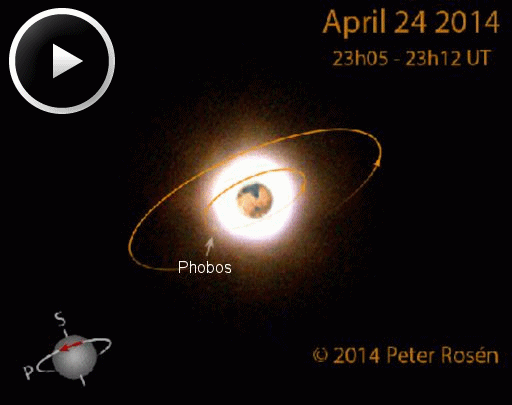
"My previous attempt at photographing Phobos and Deimos resulted in Deimos alone, so I tried again last night, slightly changing my setup," says Rosén. "This time I managed to get the even more elusive Phobos at mag. 11.8 , separated only by 11 arcseconds from the blindingly bright Mars at mag. -1.28."
"I inserted the orbital path of both moons to show how much closer Phobos is to the planet compared to Deimos and also that Phobos is on track."
"So why doesn't Deimos show in this 2-frame animation?," he asks. "It was positioned below the planet at a separation of 15 arcseconds at that time and being a full magnitude dimmer (almost 13) it was just invisible."