MOTHER'S DAY AT THE EDGE OF SPACE: Mother's Day is right around the corner. Looking for a unique gift? How about an Edge of Space Mother's Day Card? This weekend, the students of Earth to Sky Calculus will launch a helium balloon to the stratosphere. For only $49.95, your Mother's Day, Father's Day, birthday or anniversary card could be on the payload. Profits from the flight are used to support the students' space weather balloon research program. Contact Dr. Tony Phillips for details.

ANVIL SCREAMER: In a remote area of New Mexico, amateur astronomer Thomas Ashcraft operates a shortwave radio observatory. He routinely records bursts of radio energy from the sun and Jupiter, as well as echoes from passing meteors. On April 20th, a more hair-raising sound emerged from the loudspeaker. "It was the banshee howl of an 'anvil screamer.'" Click on the image for a sample of what he heard:
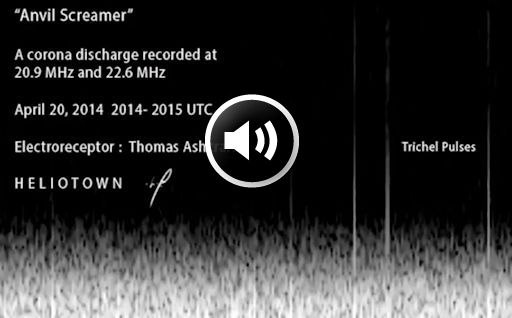
An "anvil screamer" is a burst of static caused by a thunderstorm passing directly over a radio telescope, raising strong electric fields around the antenna. "Small corona discharges occurred off of pointy objects (grasses and cactus spines) in the vicinity of the antennas due to a charge differential between the ground and the air," says Ashcraft. "I did not look outside because I was busy disconnecting sensitive electronics, but it is possible my antennas might have been glowing violet blue in this moment with St. Elmo's Fire."
"I was able to capture a one minute forty second radio recording, which builds in intensity and frequency and then stops abruptly as I got my system unplugged," he says. "I thought a lightning bolt would surely strike as the charged anvil of the thunderhead passed by, but a strike did not occur." Listen again. "It was a close call in any case." More information about the event may be found here.
Realtime Space Weather Photo Gallery
SOLAR ECLIPSE: When the sun set over Australia on April 29th, sky watchers noticed something odd. A piece of the sun was missing. The new Moon passed in front of the sun producing a partial eclipse as deep as 70%. This was the view from Adelaide, South Australia:
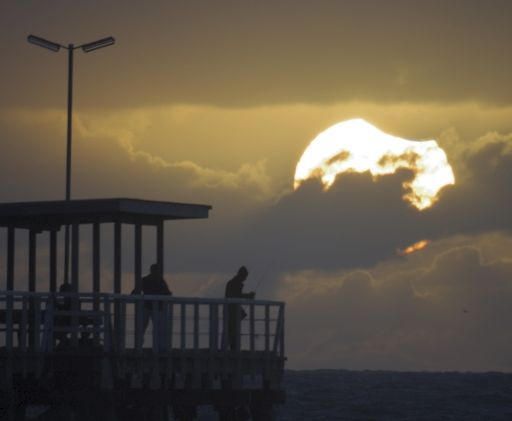
"Here the eclipse peaked at 51% and was still in progress as the sun was setting," says photographer Martin Lewicki. "We could see it clearly through the clouds."
Visibility of this eclipse was restricted to Australia and the coast of Antarctica: map. While Australians witnessed a partial eclipse, in Antarctica the Moon passed directly in front of the sun, producing a "ring of fire" annular eclipse. Photographs of that phase, however, might not be forthcoming because of the remote location. Browse the eclipse gallery for updates:
Realtime Eclipse Photo Gallery
SOLAR SUPERSTORM NARROWLY MISSES EARTH: Two years ago, a Carrington-class solar storm narrowly missed Earth. If it had hit, researchers say, we could still be picking up the pieces. Get the full story from Science@NASA. Solar flare alerts: text, voice