GET READY FOR A NEW METEOR SHOWER: May 24th could be a big day for meteor astronomy. That's when Earth is expected to pass through a cloud of debris from comet 209P/LINEAR, producing a never-before-seen meteor shower. Meteor rates could exceed 200 per hour, and some forecasters have even mentioned the possibility of a meteor storm. Get the full story from Science@NASA.
AN UPTICK IN SOLAR ACTIVITY: The sunspot number is increasing this week as a crowd of dark cores emerges over the sun's eastern limb. Click to view a 3-day movie from the Solar Dynamics Observatory (SDO), and count the spots as they appear:

One of the spots in the crowd, AR2056, has a 'beta-gamma' magnetic field that harbors energy for M-class solar flares. The odds of a geoeffective eruption will increase in the days ahead as AR2056 turns toward Earth. NOAA forecasters estimate a 25% chance of M-flares on May 8th.
Update: As predicted, sunspot AR2056 unleashed a M5-class solar flare on May 8th at 1007 UT. SDO captured the extreme ultraviolet flash:

The flash ionized the upper layers of Earth's atmosphere, interfering with shortwave radio propagation on the dayside of the planet. Those effects, however, quickly subsided. Also, first-look coronagraph images from the STEREO spacecraft show no significant CME emerging from the blast site. Stay tuned for updates as more data become available.Solar flare alerts: text, voice
Realtime Space Weather Photo Gallery
WEAK INTERPLANETARY SHOCK SPARKS AURORAS: A interplanetary shock wave, origin unknown, hit Earth's magnetic field during the late hours of May 7th. Although the shock was relatively weak, the impact was enough to spark auroras over Canada and some northern-tier US states. Mike Taylor sends this picture of the display from Central Maine:
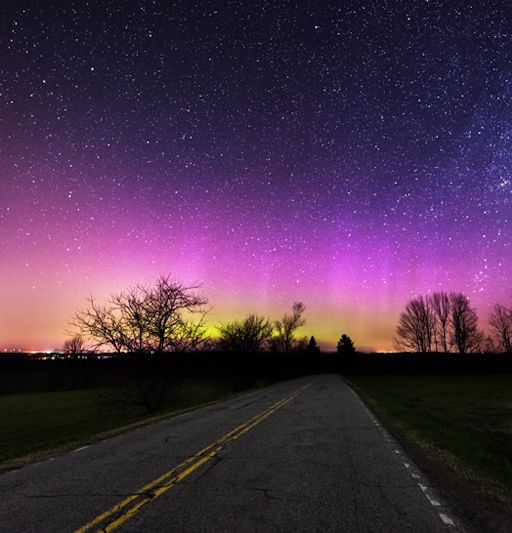
"While out photographing our Milky Way galaxy in the middle of the night, I happened to notice some color coming from the North and sure enough it was the Northern Lights," says Tayler. "Although I could barely see this display with the naked eye, the camera picked it up quite well. Bright lights and other colors on either side of the aurora are man-made light pollution coming from Augusta, Maine, about 20 miles away."
In the wake of the shock, solar wind conditions favor more high-latitude auroras tonight. First-time photographers, check out Taylor's photo settings. They might come in handy in your own backyard. Solar flare alerts: text, voice
MOTHER'S DAY AT THE EDGE OF SPACE: Mother's Day is right around the corner. Looking for a unique gift? How about an Edge of Space Mother's Day Card? The students of Earth to Sky Calculus are about launch another helium balloon to the stratosphere. For only $49.95, your Mother's Day, Father's Day, birthday or anniversary card could be on the payload. Profits from the flight are used to support the students' space weather balloon research program. Contact Dr. Tony Phillips for details.
