GET READY FOR A NEW METEOR SHOWER: May 24th could be a big day for meteor astronomy. That's when Earth is expected to pass through a cloud of debris from comet 209P/LINEAR, producing a never-before-seen meteor shower. Meteor rates could exceed 200 per hour, and some forecasters have even mentioned the possibility of a meteor storm. Get the full story from Science@NASA.
WILD SWx BALLOON LAUNCH: This morning, May 10th, the students of Earth to Sky Calculus sent another space weather balloon to the stratosphere. The launch occurred in windy weather, which made the inflated balloon unusually difficult to control. In this video, listen to the reaction of the students as the balloon barely clears the roof of a house next-door to the launch site:
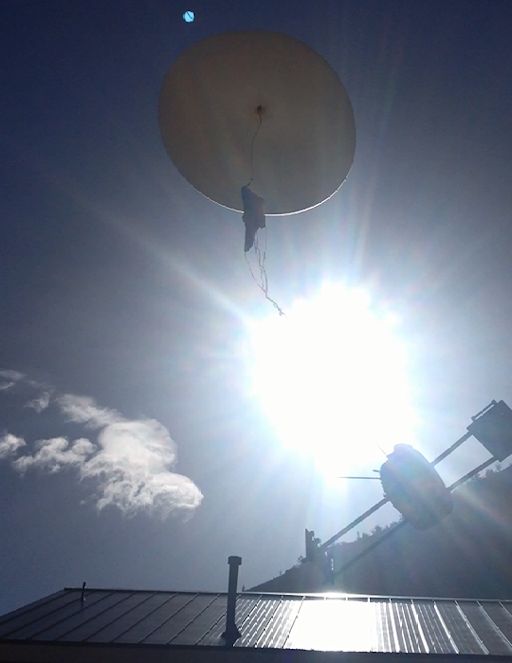
In addition to its usual sensors for temperature, altitude, and cosmic radiation, the payload carried four colonies of halobacteria. The students are exposing these bacteria to Mars-like conditions at the edge of space in a continuing series of experiments to find out if terrestrial extremophiles could live on other planets. Stay tuned for updates. So far so good: They survived the launch! Stay tuned for updates after the payload is recovered from its landing site near Death Valley later today.
Realtime Space Weather Photo Gallery
SOUTHERN CORONAL HOLE: Imagine what it would be like if, from time to time, a hole opened up in Earth's atmosphere and air went blowing out into space. On the sun, this happens all the time. The openings are called "coronal holes." NASA's Solar Dynamics Obervatory is monitoring one right now; it is the dark wedge-shaped region in this extreme ultraviolet image of the sun's southern hemisphere:
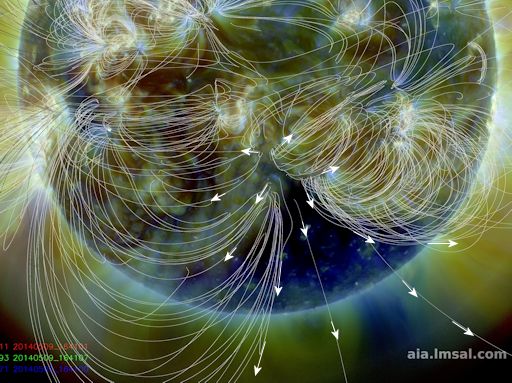
Coronal holes are places in the sun's atmosphere where the magnetic field bends back and allows gas to escape. From such openings, solar wind blows out into space. A stream of solar wind flowing from this particular coronal hole could reach Earth on May 11-12, sparking auroras when it arrives. On the other hand, the stream might sail south of our planet, delivering only a glancing blow. Stay tuned for updates. Aurora alerts: text, voice
Realtime Space Weather Photo Gallery