INCREASING CHANCE OF FLARES: NOAA forecasters have boosted the odds of an M-class solar flare today to 50% mainly in response to the rapid growth of a new sunspot in the sun's southern hemisphere. The sunspot, designated AR2060, has a 'beta-gamma' magnetic field that harbors energy for strong eruptions. Solar flare alerts: text, voice
HALOBACTERIA SET NEW HIGH-ALTITUDE RECORD: Over the weekend, the students of Earth to Sky Calculus launched a space weather balloon to the stratosphere carrying four colonies of halobacteria. During the flight, the microbes set a high-altitude ballooning record for their species. Here they are floating 112,000 feet above Earth's surface:

In the image, the sky is black not because it is night, but rather because the balloon is floating above 99% of Earth's atmosphere. The payload was on the doorstep of space itself. During the 90 minute ascent, the microbes were exposed to temperatures as low as -58 C and cosmic radiation levels more than 25 times Earth-normal. These conditions are akin to the planet Mars. The students are exposing halobacteria to the Mars-like environment above 100,000 feet in a continuing series of experiments to find out if terrestrial extremophiles could live on other planets. Incubation begins tomorrow in the high school AP Biology Lab. Stay tuned for updates.
Realtime Space Weather Photo Gallery
VAN GOGH CLOUDS: For a moment, yesterday, June Grønseth was transported from her home in Lofoten, Norway, into the realm of Vincent van Gogh. "I looked out the wndow and saw some really big Kelvin-Helmoltz waves passing by," she says. This is one of two photos she took:
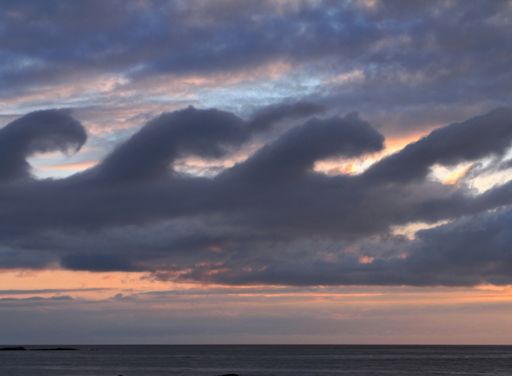
These clouds, sometimes called "billow clouds," are produced by the Kelvin-Helmholtz instability when horizontal layers of air brush by one another at different velocities. A better name might be van Gogh clouds: It is widely believed that these waves in the sky inspired the swirls in van Gogh's masterpiece The Starry Night.
Realtime Space Weather Photo Gallery