SOLAR SECTOR BOUNDARY CROSSING: High-latitude auroras are possible on May 22nd when Earth crosses through a fold in the heliospheric current sheet. This is called a "solar sector boundary crossing," and NOAA forecasters estimate a 20% chance of polar geomagnetic storms when it occurs. Aurora alerts: text, voice
NEW METEOR SHOWER ON EARTH AND THE MOON: Anticipation is building as Earth approaches a cloud of debris from Comet 209P/LINEAR. This weekend, meteoroids hitting Earth's atmosphere could produce a never-before-seen shower called the "May Camelopardalids" peaking with as many as 200 meteors per hour. The best time to look is on Saturday, May 24th, between 0600 UT and 0800 UT (2 a.m. and 4 a.m. EDT).
Earth won't be the only body passing through the debris zone. The Moon will be, too. Meteoroids hitting the lunar surface could produce explosions visible through backyard telescopes on Earth. The inset in this picture of an actual lunar meteor shows the region of the crescent Moon on May 24th that could be pelted by May Camelopardalids:
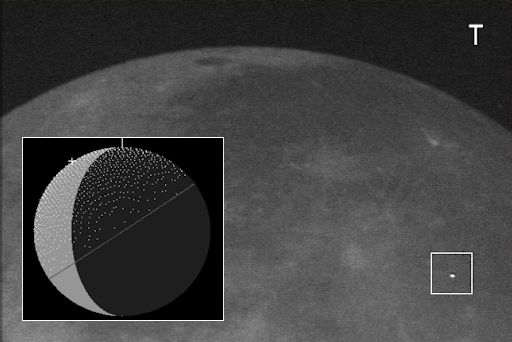
According to NASA's Meteoroid Environment Office, the best time for amateur astronomers to scan the Moon for lunar meteors is after 0800 UT (4 a.m. EDT) on May 24th.
There is much uncertainty about the strength of this shower, both on Earth and on the Moon. In recent history, our planet has never passed directly through a debris stream from Comet 209P/LINEAR, so no one knows exactly how much comet dust lies ahead. A magnificent meteor shower could erupt, with streaks of light in terrestrial skies and sparkling explosions on the Moon--or it could be a complete dud. Stay tuned!
Realtime Meteor Photo Gallery
[listen: meteor radar]
SOLAR 'MINI-MAX': Last month at the Space Weather Workshop in Boulder, Colorado, solar cycle expert Doug Biesecker of NOAA announced that "Solar Maximum is here, finally." According to his analysis, the sunspot number for Solar Cycle 24 is near its peak right now. Spoiler: It's not very impressive. "This solar cycle continues to rank among the weakest on record," says Workshop attendee Ron Turner of Analytic Services, Inc. To illustrate the point, he plotted the smoothed sunspot number of Cycle 24 vs. the previous 23 cycles since 1755:

In the composite plot, Cycle 24 is traced in red. Only a few cycles since the 18th century have have had lower sunspot counts. For this reason, many researchers have started calling the ongoing peak a "Mini-Max."
"By all Earth-based measures of geomagnetic and geoeffective solar activity, this cycle has been extremely quiet," notes Turner. "However, Doug Biesecker has presented several charts showing that most large events such as strong flares and significant geomagnetic storms occur in the declining phase of the solar cycle."
In other words, there is still a chance for significant solar activity in the months and years ahead. Let's just hope it is not too significant. Solar flare alerts: text, voice
Realtime Space Weather Photo Gallery