QUIET SUN: Solar activity is low. Although there are more than half-a-dozen sunspots on the solar disk today, not one has the type of complex magnetic field that harbors energy for strong eruptions. NOAA forecasters estimate a 10% chance of M-flares and a scant 1% chance of X-flares on May 22nd. Solar flare alerts: text, voice
ANTICIPATION BUILDS FOR WEEKEND METEOR SHOWER: This weekend, Earth will pass through a stream of debris from Comet 209P/LINEAR. If forecasters are correct, the encounter could produce an outburst of bright meteors numbering more than 200 per hour. The best time to look for these "May Camelopardalids" is on Saturday, May 24th, between the hours of 0600 UT and 0800 UT (2 a.m. and 4 a.m. EDT). The timing favors observers in North America.
It is often said that this is a new shower, and no one has ever seen a May Camelopardalid before. Well...maybe just one. "We searched through our database of several thousand bright meteors and found a likely candidate," reports Bill Cooke of NASA's Meteoroid Environment Office. "Back on May 9th of 2012, one of our all-sky cameras caught it burning up at an altitude of 66 kilometers." This is what it looked like:
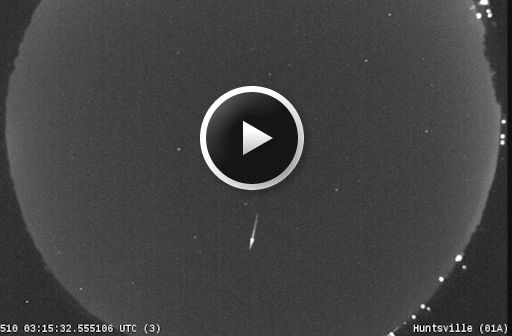
"Peaking at a magnitude of -2 (Mars brightness), our now-extinct visitor was about 3.3 cm in diameter - a little smaller than a ping pong ball," continues Cooke. "We believe it was a May Camelopardalid because it had an orbit that greatly resembles that of parent Comet 209P/LINEAR." The diagram, below, shows the match:

"So why is this good?" asks Cooke. "Looking back to 2012, our computer models show very little comet debris near Earth. We predicted nothing, yet got one meteor. Does this mean that a legion of his siblings will show up this year, when the models suggest the potential of a full-fledged meteor outburst? I'm getting excited about Friday night/Saturday morning."
Earth won't be the only body passing through the debris zone. The Moon will be, too. Meteoroids hitting the lunar surface could produce explosions visible through backyard telescopes on Earth. The inset in this picture of an actual lunar meteor shows the region of the crescent Moon on May 24th that could be pelted by May Camelopardalids:

According to NASA's Meteoroid Environment Office, the best time for amateur astronomers to scan the Moon for lunar meteors is after 0800 UT (4 a.m. EDT) on May 24th.
There is much uncertainty about the strength of this shower, both on Earth and on the Moon. As far as we know, our planet has never passed directly through a debris stream from Comet 209P/LINEAR, so no one knows exactly how much comet dust lies ahead. A magnificent meteor shower could erupt, with streaks of light in terrestrial skies and sparkling explosions on the Moon--or it could be a complete dud. Stay tuned!
Realtime Meteor Photo Gallery
[listen: meteor radar]
Realtime Space Weather Photo Gallery