QUIET SUN: Solar activity is low. Two sunspots (AR2071 and AR2073) have 'beta-gamma' magnetic fields that harbor energy for M-class solar flares, but both are stable. A quiet weekend seems likely. Aurora alerts: text, voice
MAY CAMELOPARDALID METEOR UPDATE: Note to sky watchers: That's not what a meteor storm looks like. Last night, as predicted, Earth passed through a stream of debris from Comet 209P/LINEAR, and the encounter did produce a number of fine meteors. However, contrary to some forecasts, there was no intense outburst. Typical naked-eye meteor rates were no more than 5 or 10 per hour, a far cry from the "meteor storm" some headlines anticipated.
"Even though the meteor shower was less than spectacular, it was still nice to spend the night camping out under dark skies," says Kevin Palmer of Illinois. " I captured this fireball over the Green River State Wildlife Area at 2:24 am."
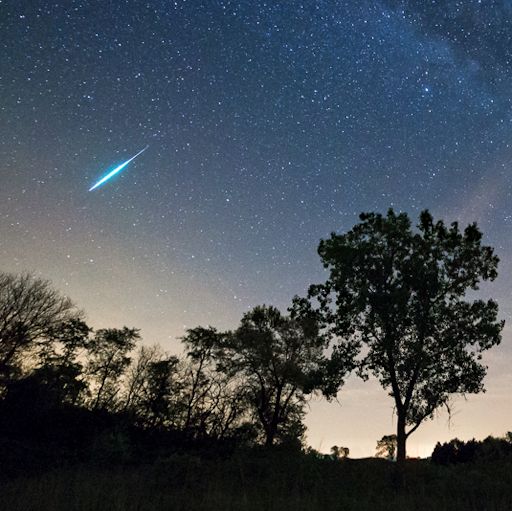
The modest display was hardly surprising. The parent comet, 209P/LINEAR, is faint and currently produces only a small amount of dust. Most forecasters acknowledged that there might be less debris in Earth's path than their models suggested.
It is worth noting, and perhaps marveling, that forecasters correctly predicted the onset of a never-before-seen meteor shower. They got the timing almost perfectly correct; only the rates were off. Such a prediction would have beeen impossible only 20 years ago before the development of physics-based dust stream models. In this respect, the May Camelopardalids were a success if not a spectacle.
MEANWHILE IN THE STRATOSPHERE: As seen from ground level, the May Camelopardalids were a bit of a dud. But what was the shower like in the stratosphere? To find out, the students of Earth to Sky Calculus launched a helium balloon equipped with a low-light meteor camera. Here they are inflating the balloon and releasing it into the midnight sky above the Sierra Nevadas of central California:
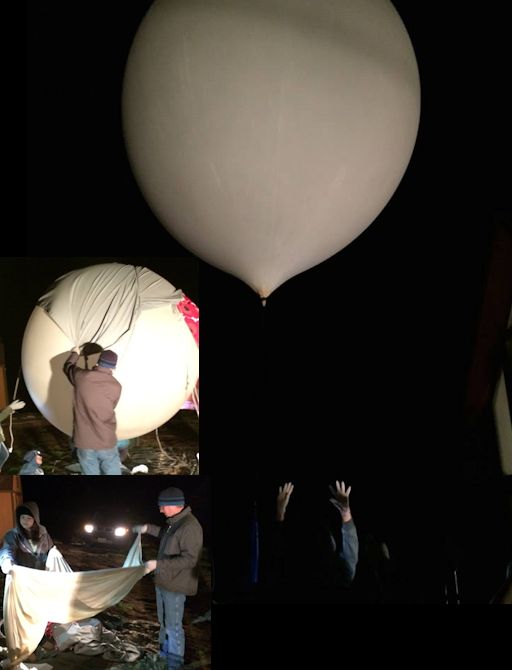
The balloon's 3 hour flight coincided with the predicted peak of the shower. During that time the payload was floating above 99% of Earth's atmosphere for almost an hour. The student's camera had a front row seat for the meteor display, such as it was.
The next step is to recover the camera, which is not as easy as launching it. The payload and its digital cache of photos landed in a remote area of the Sierra Nevada backcountry. Tomorrow, a student recovery team will enter the Sierra National Forest tomorrow to retrieve the payload from a forested area near Paradise Peak. Stay tuned for updates.
Realtime Space Weather Photo Gallery