QUIET WITH A CHANCE OF FLARES: Solar activity is low. However, departing sunspot AR2065 has a 'beta-gamma' magnetic field that harbors energy for M-class solar flares. If such an explosion does occur, it would be well-connected to Earth. The sun's spiralling magnetic field leads from the sun's western limb, where AR2065 is located, almost directly back to our planet. Solar flare alerts: text, voice

FIRST NOCTILUCENT CLOUDS OF THE SEASON: Data from NASA's AIM spacecraft have shown that noctilucent clouds (NLCs) are like a great "geophysical light bulb." They turn on every year in late spring, reaching almost full intensity over a period of no more than 5 to 10 days. News flash: The switch has been flipped. "The first NLCs of the northern hemisphere season appeared on May 24th," reports Cora Randall, AIM science team member at the University of Colorado. Pale-blue and wispy, they are circled in this image of the Arctic Circle taken by AIM's CIPS instrument just three days ago:

Last year, for reasons that are not fully understood, noctilucent clouds appeared earlier than usual. In 2014, however, "we are having a fairly normal start," says Randall. "Since AIM was launched in 2007, we have seen start dates typically ranging from May 15th to May 27th, with four seasons (like this one) getting underway between May 24th and May 27th."
If this season follows the pattern of earlier seasons, the small wispy patches pictured above will grow into a magnificent ring of electric-blue clouds in 5 to 10 days--that is, by the first week of June. Then the geophysical light bulb will be fully aglow. Stay tuned for sightings.
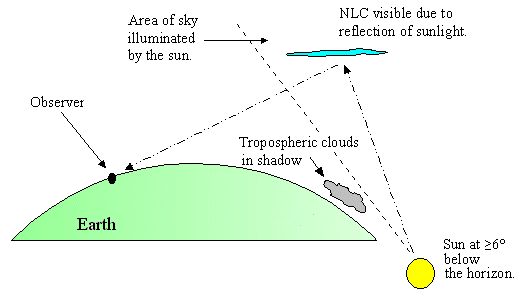
Observing tips: NLCs favor high latitudes, but they are not confined there. In recent years the clouds have been sighted as far south as Colorado and Virginia. Look west 30 to 60 minutes after sunset when the Sun has dipped 6o to 16o below the horizon. If you see luminous blue-white tendrils spreading across the sky, you may have spotted a noctilucent cloud.
Realtime Space Weather Photo Gallery
THE RADAR CAMELOPARDALIDS: On May 24th, many sky watchers were disappointed when the Camelopardalid meteor shower produced a measley 5 to 10 shooting stars per hour. At least 10 times that number had been expected. In fact, they were there, just invisible to the human eye. "The shower was quite strong as seen by radar, but almost exclusively in underdense echoes - that is, it was rich in faint meteors (i.e., 6th to 7th magnitude)," reports Peter Brown of the University of Western Ontario. This all-sky radar map obtained during the shower's peak by the Canadian Meteor Orbit Radar clearly shows a Camelopardalid 'hot spot' near the north celestial pole:

"CMOR detected about one hundred orbits from the stream, making this comparable to the 2011 Draconids in terms of strength as seen by the radar," says Brown. "[Compared to other minor showers active on May 24th], the May Camelopardalids were at the top of the list -- relatively speaking a major outburst."
If only it had been a major outburst of visible meteors....
Clearly, the debris stream of parent comet 209P/LINEAR did not contain as many large particles as forecasters anticipated. This gave the advantage to the radar. Even so, some beautiful Camelopardalids were seen by the naked eye. Browse the gallery for examples.