QUIET SUN: Solar activity remains low. Not one of the sunspots scattered across the visible disk of the sun possesses the kind of complex magnetic field that poses a threat for strong eruptions. NOAA forecasters estimate a 15% chance of M-flares today, declining to 10% tomorrow. Solar flare alerts: text, voice
COMET 209P/LINEAR FLIES BY EARTH: On Thursday, May 29th, Comet 209/LINEAR will make a remarkably close flyby of Earth. At a distance of only 5 million miles (0.0554 AU), it will be the 9th closest comet flyby in recorded history. Such an encounter should be good news for sky watchers. Just one problem: the comet is not only remarkably close, but also remarkably dim. Observing from Australia, Nirmal Paul needed a half-meter telescope to take this picture of the comet approaching on May 28th:
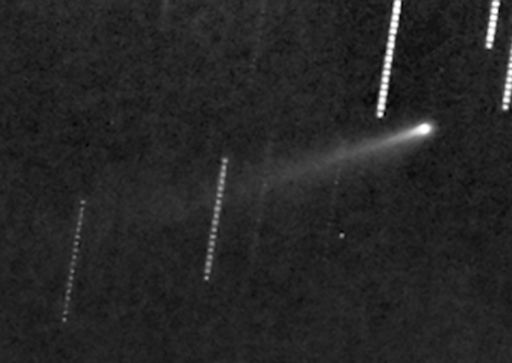
Despite its proximity to Earth, the comet is shining like a 10th or 11th magnitude star--that is, about 100 times too dim to see with the unaided eye. The comet is not very active and it currently produces very little dust. This will come as no surprise to anyone who watched the May Camelopardalid meteor shower on May 24th. Caused by dust from Comet 209P/LINEAR, the shower was a visual dud.
Amateur astronomers who wish to watch this stealthy comet pass by Earth should consult the detailed finder charts provided by Sky and Telescope. Check the comet gallery for updates:
FIRST NOCTILUCENT CLOUDS OF THE SEASON: Data from NASA's AIM spacecraft have shown that noctilucent clouds (NLCs) are like a great "geophysical light bulb." They turn on every year in late spring, reaching almost full intensity over a period of no more than 5 to 10 days. News flash: The switch has been flipped. "The first NLCs of the northern hemisphere season appeared on May 24th," reports Cora Randall, AIM science team member at the University of Colorado. Pale-blue and wispy, they are circled in this image of the Arctic Circle taken by AIM's CIPS instrument just three days ago:

Last year, for reasons that are not fully understood, noctilucent clouds appeared earlier than usual. In 2014, however, "we are having a fairly normal start," says Randall. "Since AIM was launched in 2007, we have seen start dates typically ranging from May 15th to May 27th, with four seasons (like this one) getting underway between May 24th and May 27th."
If this season follows the pattern of earlier seasons, the small wispy patches pictured above will grow into a magnificent ring of electric-blue clouds in 5 to 10 days--that is, by the first week of June. Then the geophysical light bulb will be fully aglow. Stay tuned for sightings.
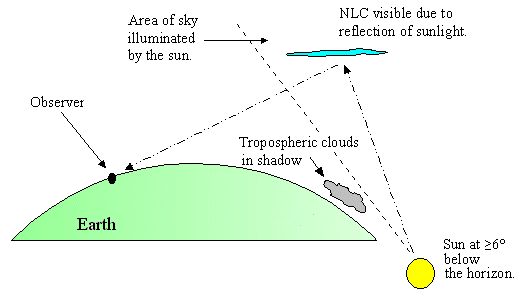
Observing tips: NLCs favor high latitudes, but they are not confined there. In recent years the clouds have been sighted as far south as Colorado and Virginia. Look west 30 to 60 minutes after sunset when the Sun has dipped 6o to 16o below the horizon. If you see luminous blue-white tendrils spreading across the sky, you may have spotted a noctilucent cloud.
Realtime Space Weather Photo Gallery