LOOK WEST AT SUNSET: For the third night in a row, there's something extra in the sunset: Jupiter and the crescent Moon. Separated by less than 10o, the two bright bodies pop out of the twilight as soon as the sun goes down. Take a look! [photo gallery]
SOLAR ACTIVITY: With no sunspots actively flaring, the face of the sun is quiet. The edge of the sun is another matter. Amateur astronomers around the world are monitoring a bushy filament of plasma seething over the sun's southeastern limb. Sergio Castillo sends this picture from his backyard observatory in Inglewood, California:

"This gigantic prominence spreading its plasma material and gases on the limb makes an excellent target for imaging," says Castillo.
The hot gas in this prominence is held aloft by solar magnetic fields. If those fields become unstable the structure could collapse, causing an explosion when it hits the stellar surface below. This kind of explosion, which occurs without the aid of a sunspot, is called a "Hyder flare."
Readers with backyard solar telescopes are encouraged to monitor the limb for developments. Solar flare alerts: text, voice
Realtime Space Weather Photo Gallery
NOCTILUCENT CLOUDS: The Arctic Circle is beginning to glow--not with auroras, but with noctilucent clouds (NLCs). Seeded by meteor smoke, electric-blue NLCs appear every year in late spring, and grow in intensity as summer unfolds. On May 30th they descended to central Europe. Chris Kranich sends this picture from Kiel, Germany:

"Our first noctilucent clouds of 2014 were clearly visible to the naked eye," says Kranich. "They were visible all night long, though occasionally hiding behind low dark tropospheric clouds."
NASA's AIM spacecraft is orbiting Earth on a mission to study noctilucent clouds. When the spacecraft launched in 2007, the origin of the clouds was a mystery. Since then AIM has revealed not only the role of meteoroids in seeding NLCs but also how methane, a potent greenhouse gas, can boost the production of the clouds. This makes NLCs a potentially sensitive probe of climate change as well as long-distance teleconnections in Earth's atmosphere.
High above the Arctic Circle, AIM saw the first NLCs of the 2014 northern summer season on May 24th, 6 days before they appeared over Germany. More ground-level sightings may be expected in the nights ahead as the intensity of the clouds increases.
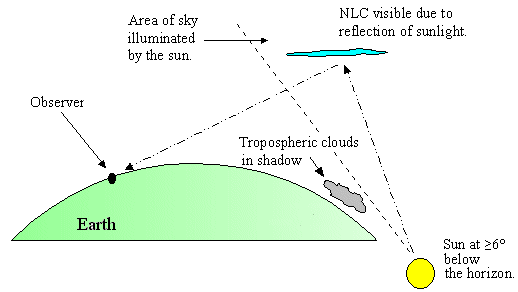
Observing tips: NLCs favor high latitudes, but they are not confined there. In recent years the clouds have been sighted as far south as Colorado and Virginia. Look west 30 to 60 minutes after sunset when the Sun has dipped 6o to 16o below the horizon. If you see luminous blue-white tendrils spreading across the sky, you may have spotted a noctilucent cloud.
Realtime Space Weather Photo Gallery