NOT-SO-QUIET SUN: Breaking a days-long spell of quiet, sunspot AR2077 unleashed an M1-class solar flare this morning. The impulsive flare, which peaked at 04:09 UT on June 3rd, probably did not hurl a CME toward Earth. Stay tuned for updates as more data are analyzed. Solar flare alerts: text, voice
MORE NOCTILUCNT CLOUDS: For the second time in just a few days, noctilucent clouds (NLCs) have been sighted in Germany. This morning shortly before sunrise, Chris Kranich spotted the telltale electric-blue ripples over Kiel:

"These second noctilucent clouds of the season appeared shortly after astronomic midnight and rose over the horizon for about two hours before disappearing in the morning twilight," says Kranich.
Noctilucent cloud season, which begins every year in late spring and stretches into summer, is just getting underway. NASA's AIM spacecraft saw the first NLCs of the northern season on May 24th. Ground-level sightings followed soon thereafter--first on May 30th and then on June 3rd. So far all of the sightings reported to spaceweather.com have come from Germany. AIM researchers aren't sure why these early NLCs seem to favor German longitudes, but they're looking into it.
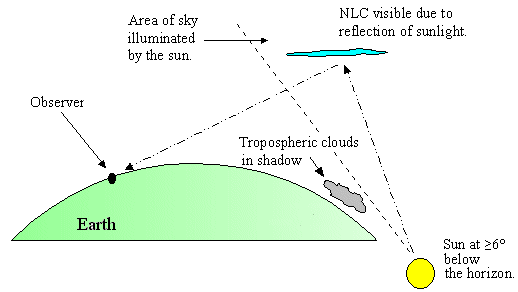
Meanwhile, sky watchers elsewhere should prepare for their own sightings. NLCs favor high latitudes, but they are not confined there. In recent years the clouds have been sighted as far south as Colorado and Virginia. Look west 30 to 60 minutes after sunset when the Sun has dipped 6o to 16o below the horizon. If you see luminous blue-white tendrils spreading across the sky, you may have spotted a noctilucent cloud.
Realtime Space Weather Photo Gallery
COMET PANSTARRS K1: On August 27, 2014, Comet C/2012 K1 PanSTARRS will buzz Earth's orbit only 0.05 AU away. Unfortunately for sky watchers, Earth won't be there. Our planet will be on the other side of the sun during PanSTARRS's close approach. A better time to photograph the comet is now. UK astronomer Damian Peach took this picture from his backyard observatory in Selsey, West Sussex, on May 31st:

His picture highlights the comet's vivid green atmosphere or "coma". The verdant hue is a sign of diatomic carbon and cyanogen, two gases that grow green when illuminated by sunligght in the near-vacuum of space.
"The comet's long ion tail is still rather faint," notes Peach. To pull it out of the starry background required a 30 minute exposure with his 4-inch telecope.
PanSTARRS K1 is currently moving through Ursa Major, shining about as brightly as an 8th magnitude star. This makes it an easy target for mid-sized backyard telescopes, albeit invisible to the naked eye. Amateur astronomers who wish to image the comet can find orbital elements and an ephemeris here.
If Earth and the comet were on the same side of the sun in August, the view would be spectacular. Disappointment will be mitigated, only a little, by images from the Solar and Heliospheric Observatory. SOHO's C3 coronagraph will track the comet as it passes behind the sun (from our point of view) from August 2nd until August 16th.