FATHER'S DAY AT THE EDGE OF SPACE: Would you like to send your dad to the Edge of Space? He can't go, but his picture can. Using a suborbital helium balloon, the students of Earth to Sky Calculus will fly the image of your choice to 120,000 ft and photograph it against the curved limb of the Earth. The returned photo (example) makes a great Father's Day gift. The flight fee is $49.95, and profits support student research. Contact Dr. Tony Phillips for details.

GROWING SUNSPOTS: Straddling the sun's equator, a pair of sunspots is rapidly emerging today. Two days ago, they were nearly invisible; now their dark cores are as large as Earth. Pay attention to the circled regions in this 48-hour movie from NASA's Solar Dynamics Observatory:

The southern sunspot, AR2080, has developed a 'beta-gamma' magnetic field that harbors energy for significant eruptions. It is now crackling with C-class flares; these flares are relatively weak but they could herald something stronger. NOAA forecasters have boosted the odds of M-flares to 10%, a figure that is likely to increase in the days ahead. Solar flare alerts: text, voice
Realtime Space Weather Photo Gallery
NOCTILUCENT CLOUDS INTENSIFY: NASA's AIM spacecraft saw the first wispy noctilucent clouds (NLCs) of the 2014 summer season on May 24th. Since then NLCs have begun to intensify around the Arctic Circle and descend to lower latitudes. This morning, June 6th, Noel Blaney spotted a bank of the electric-blue clouds over Bangor, Northern Ireland:
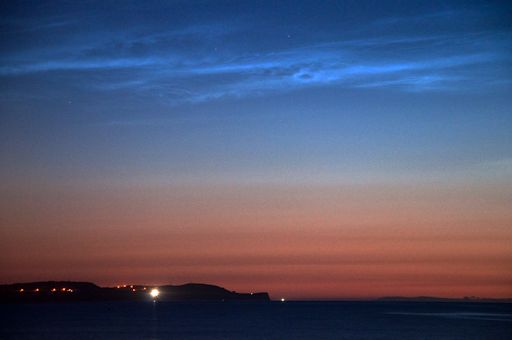
"I witnessed this nice early-season noctilucent cloud display over Belfast Lough at 2am," says Blaney. "These are my first proper images of NLCs!"
A few hours later, Lance Taylor saw more NLCs over Edmonton, Alberta. "This was my first sighting of the season - and I have been watching for them for the past two weeks now," he says.
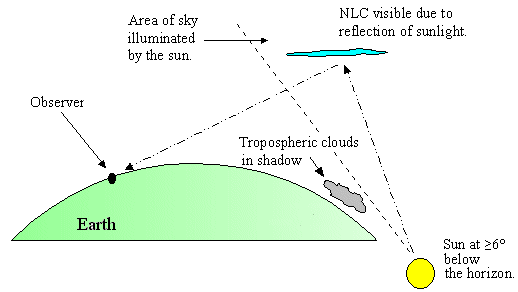
Seeded by meteor smoke and boosted by the climate-change gas methane, noctilucent clouds have been spreading beyond the Arctic. In recent years, they have been sighted as far south as Colorado and Utah. Observing tips: Look west 30 to 60 minutes after sunset when the Sun has dipped 6o to 16o below the horizon. If you see luminous blue-white tendrils spreading across the sky, you may have spotted a noctilucent cloud.

Realtime Space Weather Photo Gallery
SPACE STATION FLYBYS: North Americans, if you're outside after dark and you notice a bright light slowly gliding overhead, you've likely seen the International Space Station. This week and next the behemoth spacecraft is making a series of passes over the USA and Canada--in some places several times a day. G Taylor spotted the ISS rising above Half Dome in California's Yosemite National Park on June 1st:

"This was a lucky shot," says Taylor. " I was photographing Half Dome at the time I knew the Space Station would be making an appearance... but I didn't even know if I had the camera in the right direction. The ISS appeared just after 10pm. A sliver of a moon lit up the valley."
Taylor was under dark skies when he saw the ISS, but you don't have to be. The space station is so bright, it is visible even from light-polluted cities. Check Spaceweather.com's Simple Satellite Tracker to find out when it will fly over your hometown. ISS flyby alerts: text, voice
Realtime Space Weather Photo Gallery